Jobscan Pricing: What You’re Actually Paying For (and How to Decide in 10 Minutes)
Jobscan pricing questions usually come down to one thing: how well Insight compares your resume with the job description. Here’s a practical way to evaluate value before you commit.
Free Chrome extension
Autofill your next job application
JobWizard is a free Chrome extension that fills applications, tracks statuses, and optimizes your resume.
Jobscan pricing should be evaluated by the quality of resume-to-JD matching, not the label “AI”
When people search for jobscan pricing, they’re usually trying to answer a single decision: “Will this tool help me tailor faster and apply more confidently—or am I just paying for a score?” The best way to judge value is to look past price and focus on what the product actually does with your resume and the job description (JD), then check whether those outputs are accurate and useful for your target role.
JobWizard’s approach to the same problem is simple: compare your resume to the JD, identify gaps, and then make edits you can stand behind. The key is to use match insights to accelerate revision—not to outsource truth or assume the score equals results.
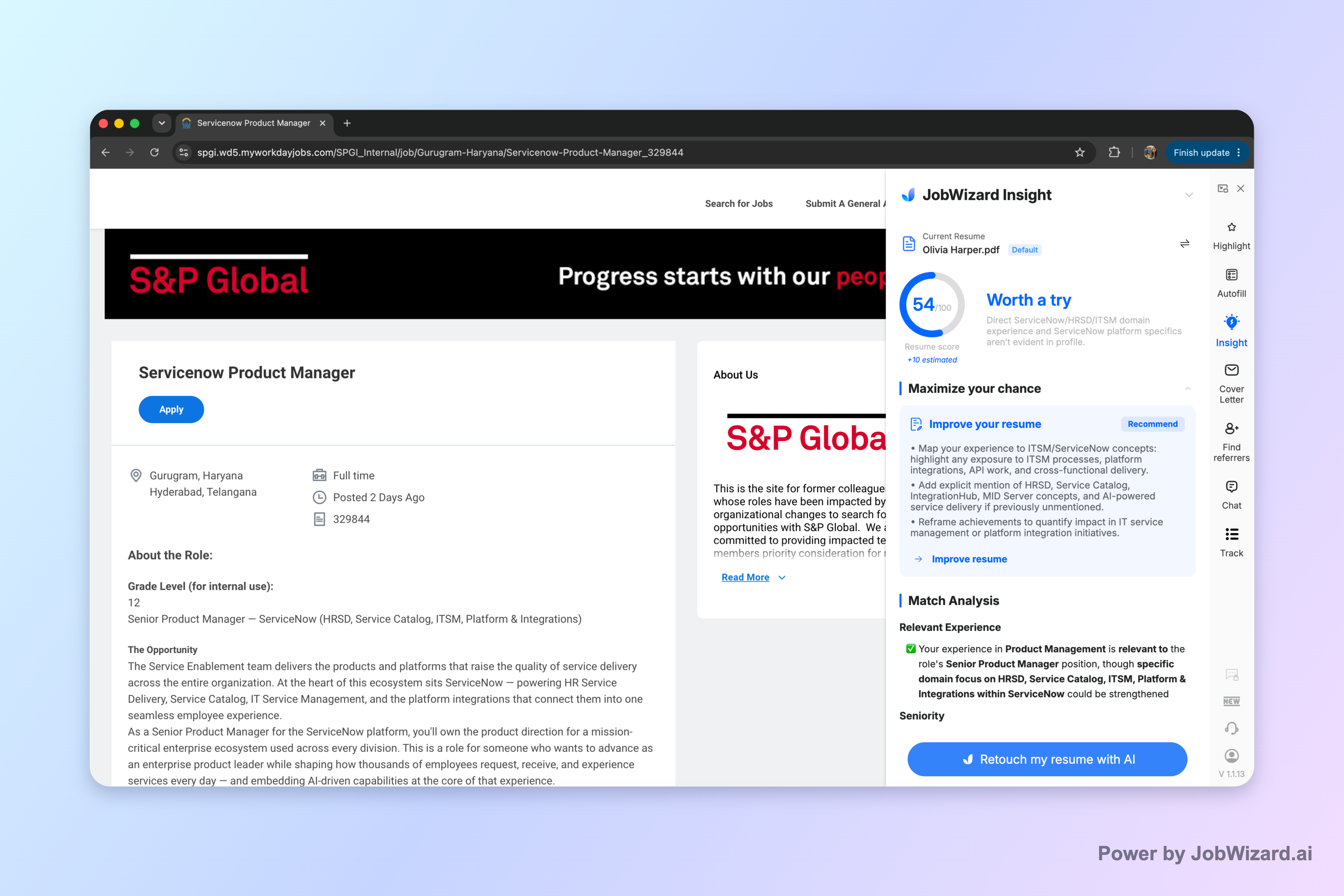
What “you’re paying for” in Jobscan pricing: Insight’s JD-based match score and gap diagnosis
If a pricing page is confusing, translate it into outcomes you can verify. With Insight, the core workflow is that it compares your selected resume with the current job description and presents a match score plus an overall assessment and improvement suggestions. It’s designed to help you spot resume expression gaps—then turn them into an editable resume revision draft based on the JD.
In other words, the “pricing value” is tied to whether the tool helps you do resume tailoring that’s anchored to the job description, not just to generic resume tips. For each target posting, you can use the output to see where your current resume doesn’t reflect how the JD describes skills, experience, or keywords.
What the match score can do
The score and associated diagnosis are meant to help you understand alignment. Specifically, Insight compares your resume with the JD and provides:
- Match score plus an overall assessment
- Improvement suggestions based on the JD
- Editable revision draft created from JD-based diagnosis of expression gaps
Important limitations before you judge “value”
To avoid paying for the wrong promise, keep two limitations front and center. The match score is not a hiring probability, and it does not guarantee ATS passage or an interview. Also, users must verify every suggested resume change and keep only accurate experience—because the output can only be as trustworthy as the information you choose to edit into your resume.
That means your evaluation should include a reality check step: do the suggested changes actually match your background and your real achievements?
A fast “10-minute value test” for Jobscan pricing using the job you’re applying to
You don’t have to guess whether jobscan pricing is worth it. Run a controlled check with a single job posting you genuinely want. Then decide based on whether the tool identifies relevant, actionable gaps you can safely fix.
- Select one target resume version you’re currently using for applications (not a “perfect” draft).
- Use the exact job description you plan to apply to, so the comparison is JD-specific.
- Review the match score + assessment to identify where the tool believes alignment is missing.
- Open the improvement suggestions as a draft and scan for what’s being changed and why.
- Verify accuracy line by line: keep only edits that reflect your true experience and skills.
- Decide if gaps are actionable: if the suggestions help you rewrite clearly and truthfully, the pricing may be justified for you.
Here’s a concrete example of what “actionable” looks like. Suppose a JD repeatedly emphasizes a specific skill phrase (e.g., “stakeholder communication” or “requirements gathering”). If your resume describes similar work using different wording, Insight’s diagnosis may help you revise expression so the resume more closely matches how the JD frames the role. If the edits are vague (“be more impactful”) or require you to claim something you didn’t do, that’s a signal to be cautious about relying on the suggestions as-is.
Should you pay based on match score alone? No—use it to guide tailoring, then review your final submission yourself
It’s tempting to treat the match score as a near-deterministic gate. Don’t. Even when the tool provides an editable draft, the process still requires your judgment. The score does not guarantee ATS passage or an interview, so the practical value is in how it informs your revisions.
Most job seekers benefit most when they use the match insights as a structured checklist—then they customize the final resume based on what they can verify. This is especially important because the tool’s recommendations are meant to reflect the JD; your job is to ensure the content remains honest and accurate.
How to tell whether you’re getting real value
Ask these questions after you review the suggested changes:
- Are the changes clearly tied to phrases and expectations in the JD?
- Can you keep the edits accurate without exaggerating responsibilities or outcomes?
- Do the suggestions produce better clarity (not just more keyword stuffing)?
- Does the draft save time because it turns a gap into concrete revision steps you can approve?
If the answers are yes, the pricing may be aligned with your needs. If the suggestions don’t help you produce a stronger, truthful resume, you may want to rethink whether that spend matches your workflow.
Do this automatically with JobWizard
Skip the manual work — JobWizard's Smart Autofill handles this for you.
Jobscan pricing FAQ: quick answers about the match score, suggestions, and how to apply the results
Is the Jobscan match score the same thing as a hiring probability?
No. Insight’s match score is an overall assessment of how your resume aligns with the job description, but it’s not a hiring probability and it doesn’t guarantee ATS passage or an interview.
What should I do with the improvement suggestions from Insight?
Verify every suggested resume change and keep only accurate experience. Insight turns JD-based diagnosis into an editable draft, but you should review it carefully so you don’t misrepresent your background.
Will Jobscan automatically apply or submit my resume for me?
This article focuses on resume-to-job-description matching. The core limitation to remember is that the score doesn’t replace your judgment—users must review and submit applications themselves.
How can I tell whether the subscription is worth it for my situation?
Compare your resume with the specific job description you’re targeting, then review the identified expression gaps. If the suggestions clearly improve alignment without risking accuracy, you’ll likely get more value than if the gaps are vague or not relevant.
Ready to decide with confidence? Use JobWizard to compare your resume to the exact job description, review the identified gaps, and then tailor only what you can verify—so your “pricing decision” is based on real, job-specific improvement rather than a number alone.
Frequently Asked Questions
Autofill your next job application
JobWizard is a free Chrome extension that fills applications, tracks statuses, and optimizes your resume.