Is Jobscan Worth It? How Match Scores Can Help You Tailor a Resume (Without Overpromising)
If you’re asking “is jobscan worth it,” start with what it does: compares your resume to the job description, shows a match score, and suggests improvements you still must verify before applying.

Free Chrome extension
See your resume's match score for any job
JobWizard compares your resume to each job description and shows the exact keywords to add — free.
Is jobscan worth it? Only if you’ll use its job-description diagnosis as a careful tailoring checklist
So, is jobscan worth it for you? The honest answer depends on whether you’ll treat it as a resume-vs–job-description reviewer—not a shortcut to guaranteed ATS success. Jobscan’s core value (through its Insight/Match Score experience) is that it compares your selected resume with a job description and surfaces a match score, an overall assessment, and improvement suggestions you can turn into a draft revision.
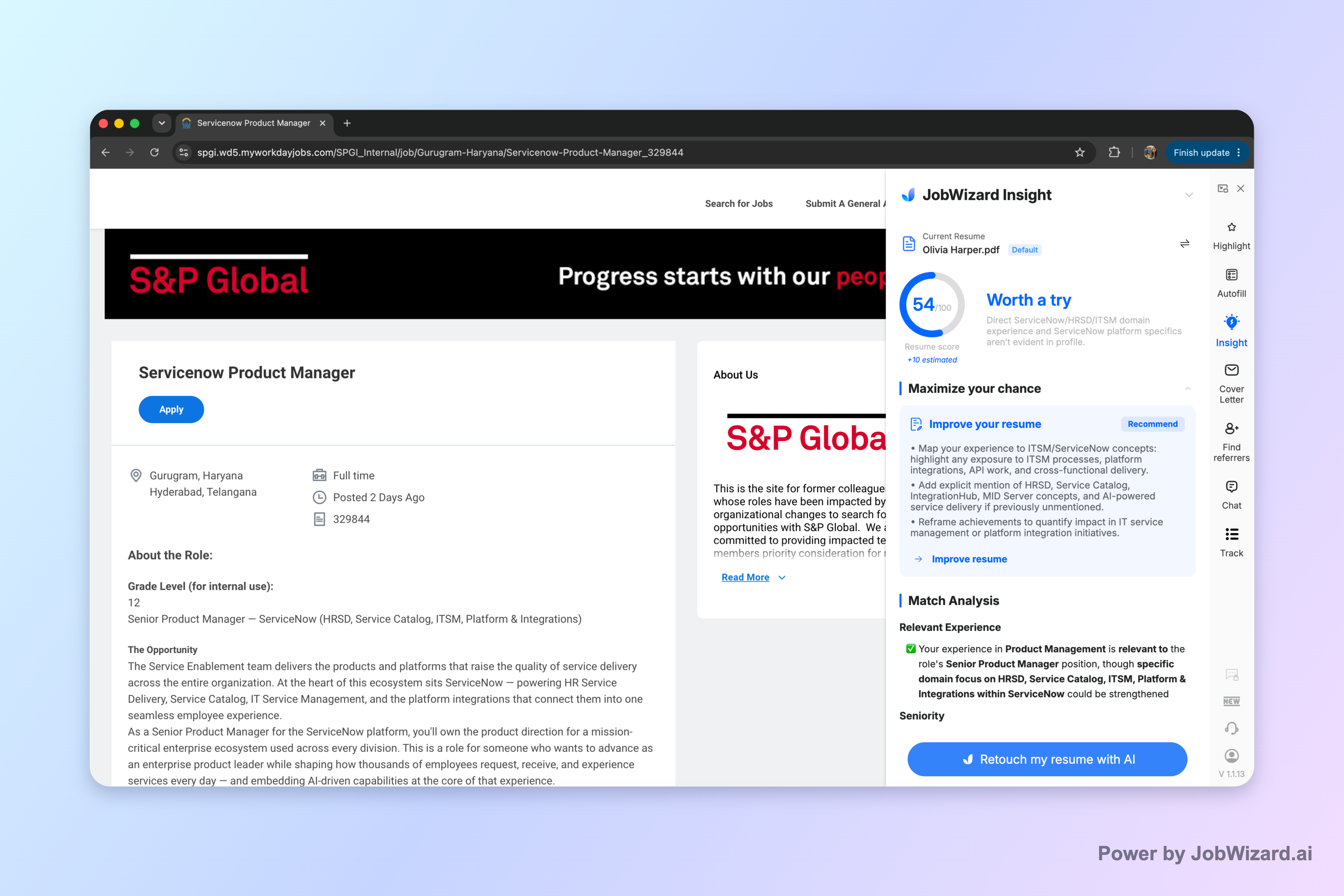
The key detail is what happens next: the job-description diagnosis can identify “expression gaps” (how your resume phrases skills and requirements) and help convert those gaps into specific next steps you can edit. That can be useful when you’re targeting competitive roles and want your resume to clearly mirror what the posting asks for—without guessing.
But don’t overpromise. The match score is not a hiring probability, and it does not guarantee ATS passage or an interview. You still have to review every suggested resume change and keep only what’s accurate.
How Jobscan’s match score helps with resume tailoring (and what it can’t do)
The most direct reason people search “is jobscan worth it” is that the output feels actionable: Insight compares your resume with the job description and provides a match score plus improvement suggestions. In practice, that means you can use the posting as the reference point and systematically evaluate where your resume might not be expressing the right skills or keywords clearly enough.
The important limitation is interpretation. The score is not a hiring probability and does not guarantee ATS passage or an interview. Even a “better match” doesn’t remove the need for a strong resume structure, truthful content, and a targeted narrative that fits the role.
What you can expect from the Insight-style workflow
- Job-description comparison: It compares your selected resume against the current job description.
- Match score + assessment: It provides an overall assessment alongside a match score.
- Improvement suggestions: It flags gaps and suggests how to improve the resume’s alignment.
- Draftable revisions: The JD-based diagnosis can turn expression gaps into an editable resume revision draft.
What you must do yourself (to avoid the common “tailoring traps”)
- Verify every suggested change: Jobscan’s suggestions should be reviewed; don’t assume they’re correct just because they appear plausible.
- Keep only accurate experience: If a suggestion pushes wording you can’t support with your real background, skip it.
- Use the job description strategically: Prioritize what the posting actually emphasizes—especially requirements that are likely to be screened first.
Quick reality-check example. Imagine a role lists “SQL for analytics” as a requirement. If your resume mentions SQL only once, you might have an expression gap: you may genuinely have the skill, but your resume doesn’t describe it clearly enough (for example, analytics context, tools used, or typical tasks). Jobscan’s match score and suggestions can help you spot that gap. However, if you’ve never used SQL in an analytics setting, you should not rewrite your history just to “improve the score.”
When Jobscan is worth it (and when it isn’t)
Is jobscan worth it? It’s most worth it when your time is limited and you want a structured way to compare your resume to the job description—then apply your judgment to revise accurately. It’s less worth it if you expect the tool to replace your decision-making or guarantee outcomes.
Worth it for people who want a job-description-first review
- You target specific roles: You paste or select job descriptions and tailor accordingly.
- You want fewer blind spots: You suspect your resume may be missing some required phrasing but aren’t sure where.
- You can review and edit: You’re comfortable verifying suggested changes and keeping content truthful.
- You want draft revisions: You’ll use the improvement suggestions to produce an editable update rather than starting from scratch.
Not worth it if your goal is “apply and forget”
- You want guaranteed ATS passage: The match score doesn’t guarantee ATS passage or an interview.
- You’re unwilling to verify accuracy: Users must verify every suggested resume change and keep only accurate experience.
- You expect the score to equal probability: The score is not a hiring probability.
Rule of thumb: If you’ll use jobscan as a diagnostic checklist to revise your resume and then do quality control, it can be worth it. If you want automation that guarantees results, it won’t match that expectation—because the tool can’t do that.
How to use Jobscan insights safely (a repeatable tailoring process)
If you decide that is jobscan worth it, the real advantage comes from how you apply the insights. The goal is to use the job-description comparison to create an editable draft of improvements, then review each change for accuracy and fit. Here’s a practical workflow you can reuse.
- Start with the exact job description: Use the posting you actually plan to apply to as the reference point.
- Run the resume vs. JD comparison: Review the match score, overall assessment, and improvement suggestions.
- Identify the “expression gaps”: Focus on where your resume phrasing may not clearly reflect what the posting requests.
- Convert suggestions into edits you can justify: Use the gap diagnosis to draft revisions, but only in ways consistent with your real background.
- Verify accuracy line-by-line: Confirm every suggested change matches your experience and achievements.
- Keep it targeted, not inflated: Prioritize relevance to the role over chasing every suggestion.
Concrete example (skills gap without misrepresentation). Suppose your resume lists “project reporting” but the job description repeatedly requests “dashboarding.” A suggested revision might prompt you to clarify what you used (e.g., reporting tools, dashboards, frequency, outcomes). If you truly built dashboards or drove analytics reporting, you can strengthen the wording. If you only did basic reports occasionally, adjust the language to reflect reality rather than adopting buzzwords you can’t defend.
Use the match score as guidance, not a verdict. It’s a resume-vs–job-description diagnostic with improvement suggestions, not a guarantee of ATS passage or an interview.
Jobscan vs your own tailoring—how to decide with confidence
Even if you’re asking “is jobscan worth it,” the real decision is whether it improves your tailoring process. If you already tailor well manually, Jobscan can still help as an additional check for expression gaps—especially when you’re managing many applications or you’re unsure what a recruiter might consider “missing.”
Before you commit, evaluate your workflow fit. Ask whether you’ll actually use the job-description-based diagnosis to create an editable revision draft and then review every change for accuracy. If yes, it’s more likely to be worth it. If no, you may not get the value the tool is designed to provide.
| Question to ask yourself | What Jobscan’s features do (relevant facts) | How to decide |
|---|---|---|
| Can the tool help me find resume expression gaps? | Insight compares your selected resume with the job description and provides a match score, assessment, and improvement suggestions. | If you want JD-based guidance on gaps, that’s aligned with the value. |
| Will a match score guarantee interviews? | The score is not a hiring probability and does not guarantee ATS passage or an interview. | If you expect guarantees, reconsider your expectations. |
| Will I verify every change? | Users must verify every suggested resume change and keep only accurate experience. | If you can commit to verification, the workflow is usable. |
| Will I revise, not just accept? | JD-based diagnosis can identify gaps and turn them into an editable resume revision draft. | If you plan to edit the resume, that’s a good match. |
Bottom line: If you treat Jobscan as a resume-vs–job-description diagnostic and do the final human review, it may be worth it. If you treat it as an “answer key” or expect guarantees, it won’t deliver.
Do this automatically with JobWizard
Skip the manual work — JobWizard's Smart Autofill handles this for you. On these platforms: JobWizard vs Jobscan.
FAQ: Is jobscan worth it for your next resume?
Is Jobscan worth it if I already tailor my resume manually?
It can still be worth it if you want a fast, job-description-based check for expression gaps. Treat the results as a review tool—verify every suggested change against your real experience before you submit.
What does Jobscan’s match score actually mean?
Jobscan’s Insight compares your resume with the selected job description and presents a match score plus improvement suggestions. The score is not a hiring probability and does not guarantee ATS passage or an interview.
Will Jobscan guarantee my resume passes ATS?
No. Even with a higher match score, it doesn’t guarantee ATS passage or an interview. Your responsibility is to review suggestions and keep only accurate, true-to-your-work changes.
How should I use Jobscan insights so I don’t misrepresent my experience?
Use the job description to identify where your resume might need clearer wording, but only revise sections that reflect real skills, responsibilities, and achievements. Verify each change and leave out anything that isn’t accurate.
What should I look for before deciding is jobscan worth it for me?
Decide based on whether you’ll use the job-description-based diagnosis to create an editable draft of revisions, then review them carefully. If you’re mainly hoping for automation or guaranteed outcomes, it’s less likely to be worth it.
Want a faster, safer way to tailor using the job description? Compare your resume to the exact role you’re targeting, then review the identified gaps before you submit—exactly the workflow approach JobWizard supports. Try JobWizard to run a job-description-based review and focus your edits where they matter most.
Frequently Asked Questions
See your resume's match score for any job
JobWizard compares your resume to each job description and shows the exact keywords to add — free.