Job Application Letter of Interest: A Practical Template + Tone Guide (With Examples)
Learn how to write a job application letter of interest that sounds specific, confident, and easy to act on—plus a cover-letter-of-interest outline you can personalize fast.
Free Chrome extension
See your resume's match score for any job
JobWizard compares your resume to each job description and shows the exact keywords to add — free.
Job application letter of interest: what it is and what hiring managers expect
A job application letter of interest is your written pitch that says, “I want to be considered,” even if you’re not responding to one exact posting. The goal is clarity and momentum: a quick summary of who you are, why the role (or team) fits, and what you’ll deliver—without making the reader work.
In practice, hiring managers look for three things fast: (1) evidence you’ve done relevant work, (2) a reason you’re reaching out now, and (3) a tone that feels professional and specific, not templated. If your letter sounds like it could go to anyone, you’ll lose attention before you ever get to your strongest accomplishments.
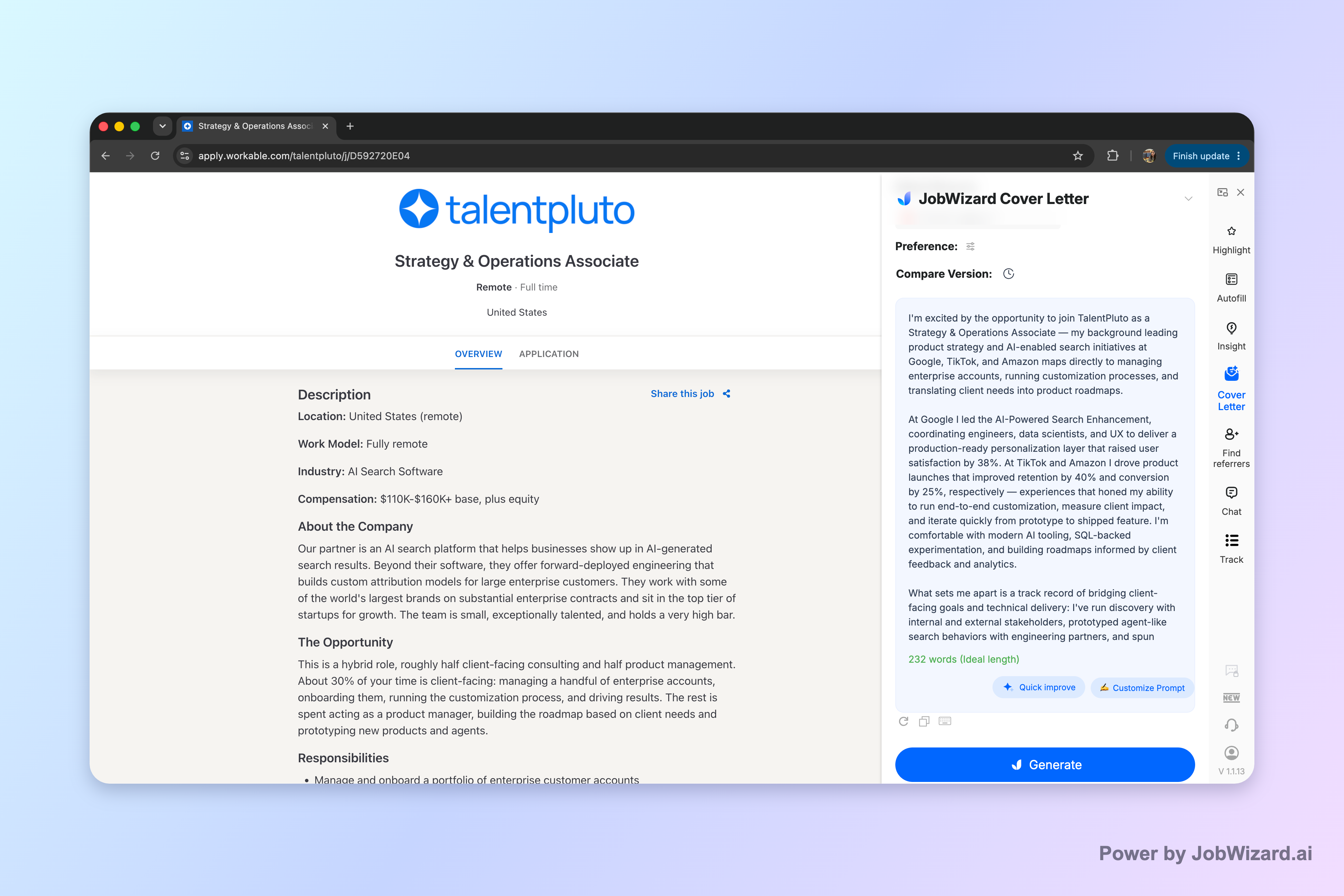
JobWizard can help you start with an editable first draft that’s generated using your selected resume and the current job description. You can then choose the length, format, tone, style, and focus, and edit the draft directly before you use it.
Use this structure for a job application letter of interest (with plug-and-play examples)
The best job application letter of interest structure is simple: a tight opening, a skills-and-impact middle, and a closing that makes next steps easy. Below is a proven template you can adapt regardless of industry.
Keep your paragraphs short—think “skimmable.” If you can remove a sentence and the meaning doesn’t change, remove it. Your letter should feel like it’s moving forward, not explaining itself.
1) Opening: make the purpose unmistakable
- Option A (role posted, but your letter adds value): “I’m writing to express interest in the [Job Title] role at [Company]. My experience in [relevant area] aligns closely with your focus on [specific theme from the posting].”
- Option B (no clear posting / general interest): “I’m interested in opportunities in [team/discipline] at [Company]. I’m drawn to your work on [mission/product/problem], and I’d welcome the chance to contribute.”
2) Middle paragraphs: prove fit with 2–3 evidence points
Hiring managers want specifics. Use a pattern like: skill → accomplishment → outcome (outcomes can be qualitative if you don’t have hard metrics).
- Example evidence point (operations): “In my current role, I redesigned intake and triage workflows, reducing handoff friction for cross-functional teams. I also built lightweight documentation so new stakeholders could ramp quickly.”
- Example evidence point (customer-facing): “I improved response quality by creating standardized templates for common issues while keeping room for unique cases. The result was faster resolution cycles and fewer repeat questions.”
- Example evidence point (technical): “I’ve shipped features end-to-end, from requirements to QA and post-release monitoring. I focus on maintainability—clear interfaces, test coverage, and pragmatic documentation.”
If you’re replying to a job description, map one paragraph to the most important themes. If you’re doing a general letter of interest, map to the company’s priorities: product direction, customer focus, engineering culture, mission, or growth goals.
3) Close: ask for a next step without being pushy
- Close example: “If it would be helpful, I’d welcome an interview to discuss how my background in [area] can support [Company/team]. Thank you for your time and consideration.”
- Close with a specific angle (optional): “I’m especially excited about [specific company detail], and I’d like to share how I approach [relevant problem] based on my experience.”
Finish with a confident, courteous sign-off. Don’t over-explain. You want the reader to see you as ready to contribute.
Write a job application letter of interest that sounds human: tone, wording, and what to avoid
Job application letter of interest letters succeed when they feel written by a real person with a clear point of view. That means specific language, accurate claims, and a tone aligned to the company’s culture.
Before you finalize, read your letter out loud. If it sounds like it was manufactured, rewrite until it sounds like you.
Choose tone that fits the situation
- Confident but not inflated: Say what you’ve done; avoid claiming “expert” status unless you can support it.
- Direct and respectful: One reason per paragraph. Avoid long introductions that repeat your resume.
- Warm professional: Show genuine interest in the company or team, but keep it grounded.
Use wording that recruiters actually scan
Swap vague phrases for concrete ones. Here are quick replacements you can use immediately.
- Instead of “I am passionate about…” → “I’ve applied [skill] to [problem] by doing [action], resulting in [impact].”
- Instead of “I have experience with…” → “I led/owned [initiative] using [tools/process], delivering [result].”
- Instead of “I’m a team player…” → “I collaborate with [stakeholders] to deliver [output] on [cadence].”
Common mistakes that weaken a letter of interest
- Generic positioning: Your letter doesn’t mention the company, the team, or the problem area.
- Resume copy-paste: You list responsibilities without connecting to outcomes or decisions.
- Overlong paragraphs: You make the reader hunt for proof of fit.
- Missing relevance: You don’t explain why your experience matters for the role/team.
How to tailor your job application letter of interest in 30 minutes (a repeatable workflow)
You don’t need hours to tailor a job application letter of interest—you need a repeatable workflow that updates the parts recruiters skim hardest.
Use this checklist every time, whether you’re responding to a posting or reaching out to a company that doesn’t list a role.
- Extract the “must-have” themes: From the job description or company page, identify 2–4 themes (e.g., scaling operations, customer experience, data-driven decisions).
- Pick your best 2–3 proof points: Choose accomplishments that directly support those themes.
- Rewrite the opening to match intent: If it’s a posted role, reference it. If it’s general interest, reference the team/mission.
- Adjust tone to the environment: Startup and enterprise may differ—keep it professional, but calibrate formality and energy.
- Confirm facts: Names, dates, tool names, and responsibilities should be accurate to your experience.
- Final scan for skimmability: Ensure each paragraph has one clear purpose and strong nouns/verbs.
When you’re not responding to a specific posting
Use a “future-fit” approach: explain what kind of work you want and what you can do for the team right away. For example, you can write about how you’d approach onboarding, process improvement, customer support quality, or product collaboration—based on your background.
- Example (general interest): “If you’re building toward [goal], I’m interested in roles where I can help by improving [process/system], collaborating with [stakeholders], and delivering [outcomes].”
Using AI drafts safely for a job application letter of interest
Job application letter of interest writing can start faster with AI—but the reader still needs your accurate story. The safest approach is “draft + review,” not blind submission.
JobWizard generates an editable cover letter draft using your selected resume and the current job description. Before generating, you can choose length, format, tone, style, and focus; after generation, you can click into the draft and edit it directly.
Key rule: you must review facts and add genuine personal details before using any AI-generated draft.
That means you should verify company/role alignment, adjust any wording that doesn’t match your voice, and add details only you can provide—specific projects, your real contribution, and the context behind your accomplishments.
What to edit before you send
- Your proof: Replace placeholders with real initiatives and how you contributed.
- Your specifics: Include one or two details that reflect your background (tools, collaboration style, domain experience).
- Your intent: Ensure the letter matches the situation: posted role vs. general interest.
- Your tone: Adjust the wording so it sounds like you, not an AI voice.
Quick template you can keep using
Copy this outline and fill it in for each application:
- Opening (2 lines): purpose + reason you’re reaching out (role/team/company).
- Proof #1 (3–4 lines): skill + accomplishment + impact.
- Proof #2 (3–4 lines): collaboration + outcome or quality improvement.
- Proof #3 (optional, 2–3 lines): technical/process strength or domain credibility.
- Close (2 lines): next step + thanks.
Do this automatically with JobWizard
Skip the manual work — JobWizard's Smart Autofill handles this for you.
FAQ: Job application letter of interest questions, answered
What’s the difference between a job application letter of interest and a cover letter?
A job application letter of interest is a targeted “I’d like to be considered” letter—often used when a role isn’t clearly posted or when you’re reaching out more broadly. A cover letter usually accompanies a specific job posting and is more tightly mapped to that listing’s requirements.
How long should a job application letter of interest be?
Aim for about one page (roughly 250–400 words). Use short paragraphs and make every sentence earn its place by tying your experience to what you want to contribute.
What tone should I use in a letter of interest for a job?
Use professional, direct, and specific. Avoid sounding generic or overly enthusiastic; instead, show calm confidence by naming relevant accomplishments and explaining why you’re a strong fit for that team or mission.
Should I mention salary, sponsorship, or EEO details in a job application letter of interest?
Keep the letter focused on fit, impact, and communication. If you’re applying through an application form that asks for salary, sponsorship, or EEO information, provide those details there; the letter itself should stay readable and focused. Always review any generated draft before using it.
How can I draft a job application letter of interest faster without losing quality?
Start by selecting your resume and the current job description (when available), then generate an editable first draft. Choose a length and tone, review the draft carefully, and add genuine personal details and any facts that need to be accurate for your situation.
Ready to write your next job application letter of interest? Generate an editable draft for the current job description in JobWizard, then review it and make it truly yours—so it’s specific, accurate, and ready to send.
Frequently Asked Questions
See your resume's match score for any job
JobWizard compares your resume to each job description and shows the exact keywords to add — free.