Is Kickresume Worth It for Job Applications? A Match-Score-First Checklist
Wondering is kickresume worth it for job applications? This review breaks down what its job-description match score can (and can’t) do—and how to use the insights without harming accuracy.

Free Chrome extension
See your resume's match score for any job
JobWizard compares your resume to each job description and shows the exact keywords to add — free.
Quick answer: Is kickresume worth it for job applications?
If you want a job-description-first way to improve wording, is kickresume worth it for job applications depends on how reliably you’ll review and verify edits before applying. Kickresume’s core value here is the ability to compare your resume against the job description and surface expression gaps you may not notice—then help you translate those gaps into a revision draft.
At the same time, the tool’s match score is not a hiring guarantee. The score doesn’t prove you’ll pass ATS or get interviews, so you still need to do the human work: confirm that any suggested changes reflect your real experience and keep your resume accurate and honest.
What Kickresume does best: match-score diagnosis for resume tailoring
The feature most relevant to your question is Kickresume’s job-description match score, which compares your selected resume with the current job description (JD). It then provides an overall assessment and improvement suggestions, focusing on ATS keyword-style alignment and skills gap wording.
In practice, this means you can take one job posting and use its language as a “target” for your resume. If the JD emphasizes a specific set of skills, tools, or responsibility phrasing, the match-score diagnosis can highlight where your resume might be expressing those ideas differently—or not at all.
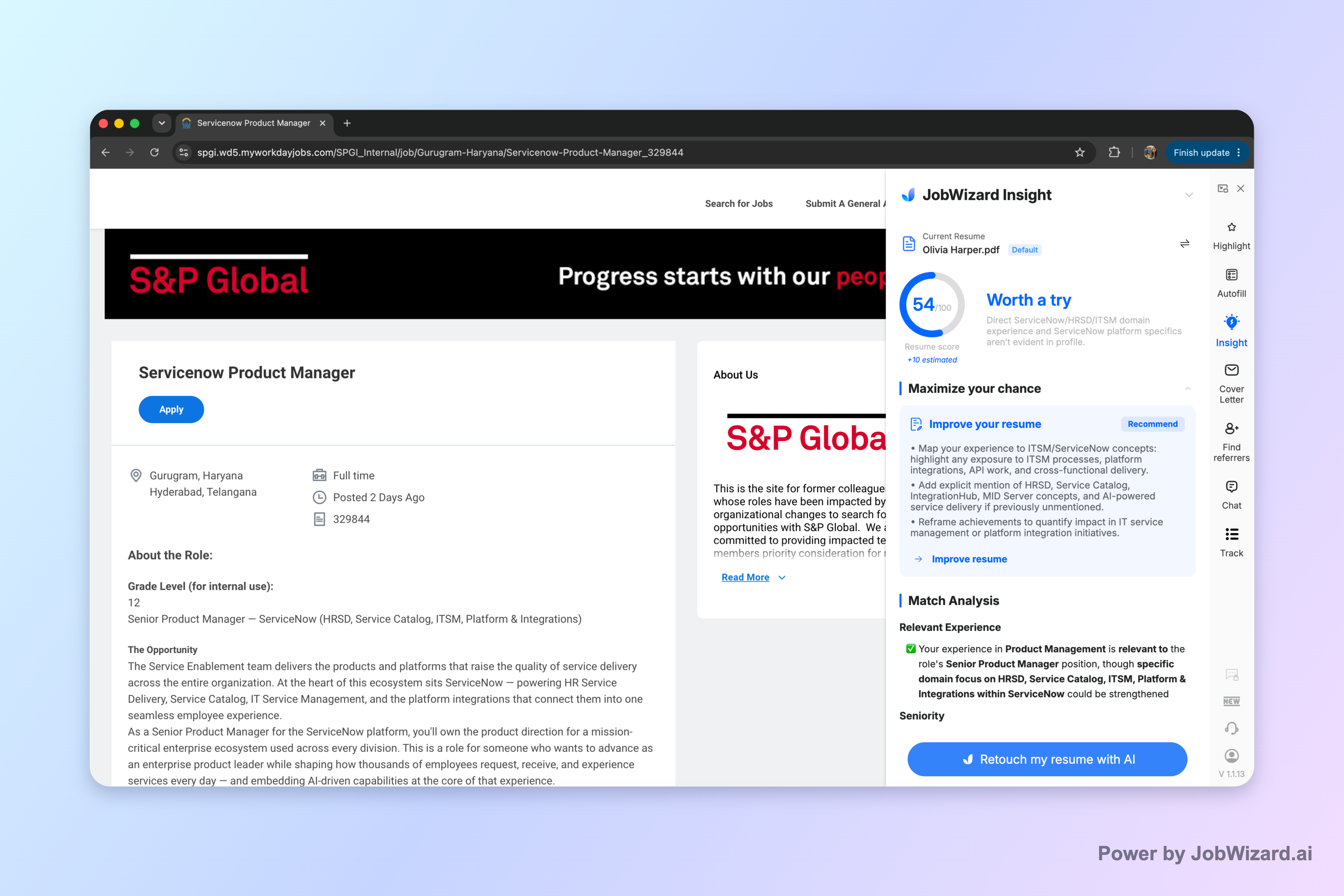
The screenshot example shows the product interaction where the system compares a resume with a Workday job description and presents a match score plus gap-driven next steps. Use this kind of workflow as a model: diagnose gaps against the exact posting, then revise intentionally rather than guessing.
How to use the match score without overreacting
- Treat the score as a “gap detector,” not an outcome predictor. Kickresume’s score is an assessment of alignment, not a hiring probability.
- Prioritize suggested changes that map to real experience. If the JD is asking for something you truly did (even with different wording), use the draft revision as a starting point.
- Convert wording gaps into editable drafts—then edit again. Kickresume’s diagnosis can identify resume expression gaps and turn them into an editable resume revision draft, but you must verify accuracy.
Limits you must understand: when “match score” won’t save you
Even if the match score looks strong, is kickresume worth it for job applications only stays true when the suggested changes remain faithful to your background. Kickresume itself flags key limitations you should plan around.
First: the score is not a hiring probability, and it does not guarantee ATS passage or an interview. A “low match” doesn’t automatically mean you’re unqualified, and a “high match” doesn’t mean you’ll get calls.
Second: the responsibility doesn’t disappear. Users must verify every suggested resume change and keep only accurate experience. If you apply changes without confirming facts, you risk creating inconsistencies that can hurt you later (during interviews, reference checks, or simple background verification).
A practical way to avoid the biggest pitfalls
- Identify the gap category. Is it missing a tool/skill, a responsibility phrase, or an ATS-relevant keyword pattern?
- Check your real history. Ask: “Did I actually do this? Under what dates and context?”
- Edit with constraints. Keep your original meaning while adopting JD-aligned phrasing.
- Remove anything you can’t defend. If you can’t explain it in an interview, don’t keep it in the resume.
When Kickresume is (and isn’t) worth your time
Kickresume tends to be worth it when you’re applying to roles that share a clear JD structure and you’re willing to review the suggested edits carefully. It’s most useful when you want to tailor faster than pure manual rewriting, but still keep control of the final content.
It’s often less worth it when your process relies on “send the same resume to everything,” or when you don’t want to spend time validating changes. Because the tool’s match score is only a diagnostic, you still have to decide what’s accurate, relevant, and credible.
Use-case examples (so you can decide fast)
- Example 1: You’re targeting a specific JD. You copy the job description, run the resume comparison, review the gaps, and revise your bullets to reflect your actual achievements using JD language.
- Example 2: You have partial experience. The system may suggest skills you don’t fully match. You can adapt by emphasizing the closest transferable tasks while keeping any missing requirements out of the resume.
- Example 3: You’re speed-testing a strong resume. Even if you think your resume is already tailored, the match score can still reveal expression gaps—use it to confirm you’re not leaving obvious keywords or responsibilities out.
How to fit this into a reliable application workflow
To keep the process grounded, build a routine around “autofill + review-before-submit”—fast content filling for repetitive parts, with your review left intact for decisions and accuracy. That approach pairs well with resume-tailoring tools because it emphasizes verification rather than blind submission.
Workflow mindset: Use AI to surface gaps quickly, then review before you submit. The match score can guide tailoring, but it doesn’t replace your judgment or fact-checking.
Also, remember that the repetitive-field angle matters when you’re applying at scale. JobWizard usage shows how autofill can quickly handle repetitive fields while leaving sponsorship/salary/EEO/custom questions for your review before submitting. That distinction matters because resume tailoring is only one layer of application quality.
Do this automatically with JobWizard
Skip the manual work — JobWizard's Smart Autofill handles this for you.
FAQ: Is kickresume worth it for job applications?
Is Kickresume worth it if I already tailor my resume?
It can still help, but only if you’ll use the match score to validate your tailoring. If your edits already cover ATS wording and job-specific skills, the main value is catching gaps you might miss—not outsourcing decisions.
Does Kickresume’s match score mean I’ll get interviews?
No. Kickresume’s score is not a hiring probability and doesn’t guarantee ATS passage or an interview. Treat it as a diagnosis of expression gaps, then verify each suggested change is accurate.
What’s the biggest risk when using Kickresume for job applications?
The biggest risk is accepting AI-suggested resume changes without checking facts. You must verify every suggested edit and keep only experience that’s true and consistent with your background.
How should I use Kickresume before submitting a job application?
Use Kickresume to compare your resume against the specific job description, review the match-score gaps, and convert them into an editable draft. Then manually tighten wording, confirm responsibilities and dates, and keep sponsorship/salary/EEO/custom answers for your own review.
When should I skip Kickresume and use a simpler approach instead?
Skip it if you’re applying with a resume that’s already aligned to the job’s key requirements, and you don’t want to review/edit suggested changes. If you won’t verify accuracy, a tool that diagnoses gaps won’t be worth the hassle.
Final take: Use Kickresume when you’ll review the edits, and use JobWizard to keep applications moving
If you’re asking is kickresume worth it for job applications, the best answer is conditional: Kickresume can be worth it when you’ll use its JD-based match score to find resume expression gaps and you’ll verify every suggested change before applying. If you want “submit-ready” results without verification, it won’t be the right fit.
Once your resume is tailored, the next bottleneck is the application itself—especially repeated form fields. If you want a faster, review-before-submit approach, try JobWizard to autofill the repetitive parts while you stay in control of the custom questions and final submission decisions.
Frequently Asked Questions
See your resume's match score for any job
JobWizard compares your resume to each job description and shows the exact keywords to add — free.