How to Answer What Interests You About This Position With Specific Proof
Learn how to answer what interests you about this position with a clear connection between the role, the employer, and your experience. Use the examples and simple framework to make your answer specific and credible.

Free Chrome extension
Let AI answer these questions for you
JobWizard fills sponsorship, work-auth, and availability answers correctly on every application — free.
Why interviewers ask what interests you about this position
Interviewers want to hear why this specific role fits your interests and what you could bring to it. When you’re figuring out how to answer what interests you about this position, don’t settle for “I’m looking for a new challenge.” Explain what caught your attention in the job and connect it to something real in your background.
The question also gives you a chance to show that you read the job description and understand the work. A useful answer sounds like a reasoned choice, not a compliment that could apply to any employer.
- Role fit: Which responsibility, problem, or area of work appeals to you?
- Relevant evidence: What experience, skill, or interest connects you to that work?
- Employer context: What have you learned about the organization that makes this role appealing?
This is related to “Why are you interested in this position?” but the interviewer may expect a more immediate, personal answer about the parts of the work that interest you. For a separate framework focused on explaining your broader motivation, read how to answer “Why Are You Interested in This Position” without sounding generic.
How to answer what interests you about this position in three steps
Build your answer around one specific part of the role, your relevant evidence, and the reason you want to do that work. This structure helps you sound prepared without memorizing a script or listing every qualification on your resume.
- Choose a role-specific detail. Pick a responsibility, customer group, tool, business challenge, or team goal from the job description.
- Connect it to your experience. Give one short example that shows a related skill, interest, or accomplishment.
- Explain what draws you to the work. Say why applying that skill in this role or organization appeals to you.
For instance, if a role involves improving how customer issues are handled, mention a time you organized feedback or helped resolve recurring problems. Then explain that you’re interested in bringing that problem-solving approach to the team’s work.
Keep your answer focused on a single through-line. You don’t need to cover your whole career history, repeat your resume, or give a sales pitch about the employer. One specific reason with supporting evidence is more memorable than several broad claims.
How to answer what interests you about this position with a tailored example
A strong answer combines a concrete job detail with an honest example from your experience. The sample below illustrates the structure; change the details to match the actual position and your own background.
“I’m interested in this position because it combines customer research with improving the product experience. In my current role, I’ve reviewed customer feedback to identify recurring issues and shared those patterns with the team. I’d like to build on that experience by helping your team turn customer insights into product improvements.”
The answer is effective because it identifies a specific combination of responsibilities, supports the interest with relevant experience, and explains what the candidate hopes to contribute. It does not claim insider knowledge or rely on generic praise.
Adapt the evidence to your situation, not the other way around. If you’re early in your career, you can draw on a class project, internship, volunteer work, or a task from another field—as long as you explain the connection clearly.
- For a career changer: Connect a transferable skill, such as coordinating projects or supporting customers, to a responsibility in the new field.
- For an entry-level role: Point to coursework, a project, or hands-on learning that sparked your interest in the work.
- For a more experienced candidate: Explain how a challenge or responsibility in the position matches the direction you want your work to take.
Make your answer specific, credible, and easy to say aloud
Use evidence you can explain, and make sure your stated interest matches the job description. Before the interview, identify one or two relevant details about the work and prepare a concise example that supports your connection to them.
- Be concrete: Replace “I love helping people” with the type of customer problem or service responsibility that interests you.
- Stay accurate: Don’t claim experience with a tool, industry, or responsibility you haven’t had.
- Show intention: Explain why this work appeals to you, rather than saying only that you need a job.
- Keep it natural: Practice the key points, but don’t memorize every word.
Also prepare for the related question “How did you hear about us?” because an interviewer may ask it as they learn what prompted your application. This answer framework for “How Did You Hear About Us?” can help you give a clear explanation without making your response sound accidental.
Check that your reasons match your priorities. If salary is one factor, be ready to discuss it separately and professionally; don’t make compensation the only reason you give for wanting the role. For that conversation, see how to answer “What Is Your Minimum Salary Requirement?”.
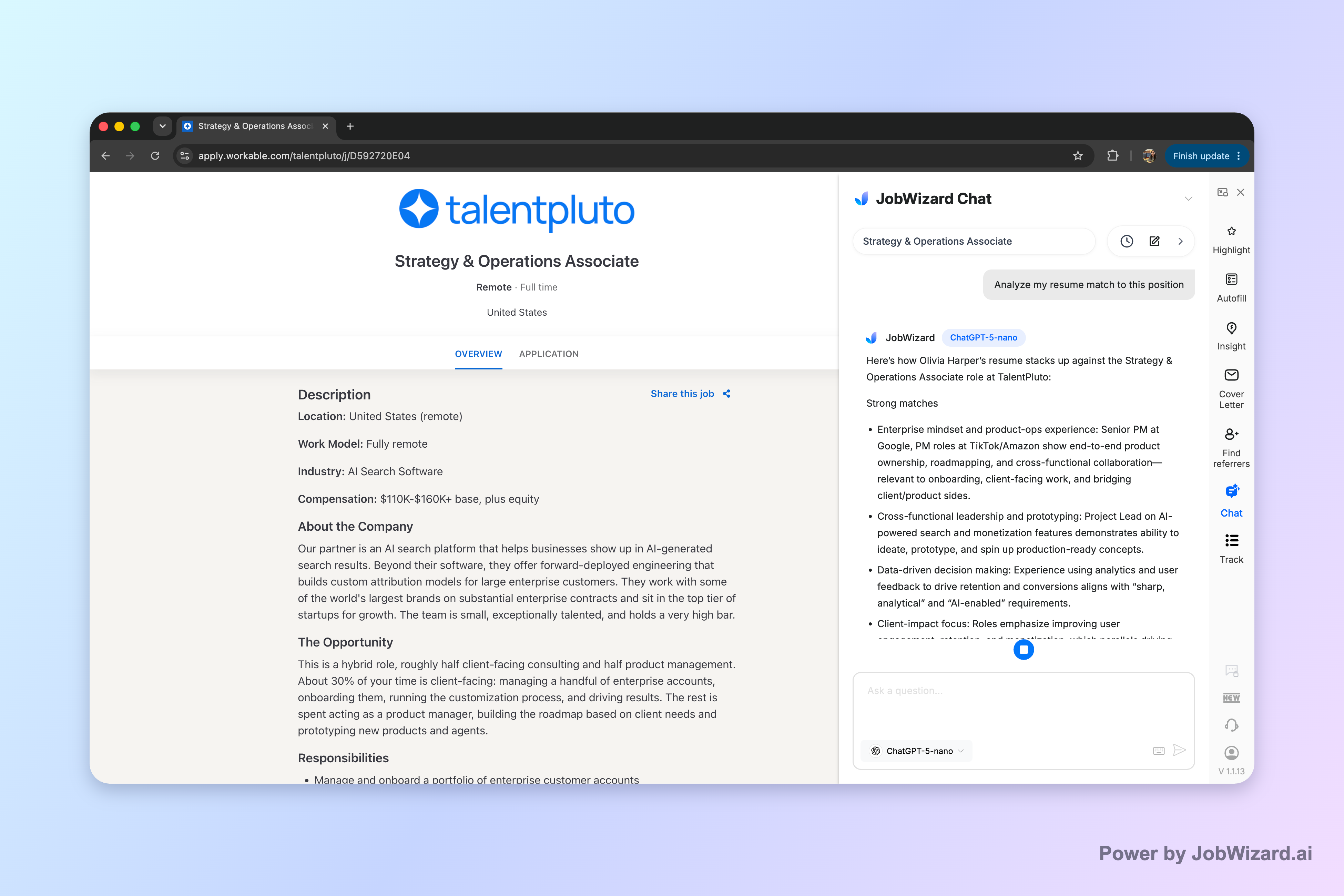
JobWizard Career Chat can keep the current role in context while you ask follow-up questions about resume fit or application strategy, without pasting the job description again. Treat its analysis as a starting point—not a recruiter’s decision or a guarantee that you qualify—and verify any suggested connection against the job description.
Do this automatically with JobWizard
Skip the manual work — JobWizard's Smart Autofill handles this for you.
FAQ: Answering what interests you about this position
A good answer is brief, specific to the role, and supported by a truthful example. Use these answers to prepare for common variations on the question.
How to answer what interests you about this position if you need a simple framework?
Use three parts: name a specific responsibility or challenge in the job description, connect it to a relevant strength or experience, and explain why the work or employer appeals to you. Keep the answer focused on this role rather than relying on general claims about wanting a new opportunity.
How do I answer what interests you about this position when I have limited experience?
Focus on relevant skills, coursework, projects, volunteering, or responsibilities from another field. Explain how one of those examples connects to a task in the role, then say what you are interested in learning or contributing.
How long should an answer to “What interests you about this position?” be?
Aim for about 30 to 60 seconds in a spoken interview. Give one or two role-specific reasons and one brief supporting example, then stop so the interviewer can follow up.
What should I avoid when answering what interests you about this position?
Avoid generic praise, focusing only on pay or benefits, repeating the job description without connecting it to your experience, or claiming expertise you cannot support. Make sure your examples are accurate and your interest is specific to the role.
Prepare your answer with the actual job description in front of you. If you want help exploring a specific role, ask JobWizard Career Chat a focused follow-up question about what interests you and how your experience connects, then verify the answer against the posting.
Frequently Asked Questions
Let AI answer these questions for you
JobWizard fills sponsorship, work-auth, and availability answers correctly on every application — free.