How to Answer Date Available for Employment: A Script That Handles Notice, Flexibility, and Follow-Ups
Learn how to answer date available for employment with clear, professional scripts for notice periods and flexible start dates—plus how to follow up if HR asks again.
Free Chrome extension
Let AI answer these questions for you
JobWizard fills sponsorship, work-auth, and availability answers correctly on every application — free.
Knowing how to answer date available for employment is one of those job-application details that can quietly make you look dependable—or unintentionally overcommitted. The goal is simple: give HR a clear earliest start date (or realistic window) while keeping flexibility for scheduling and next steps.
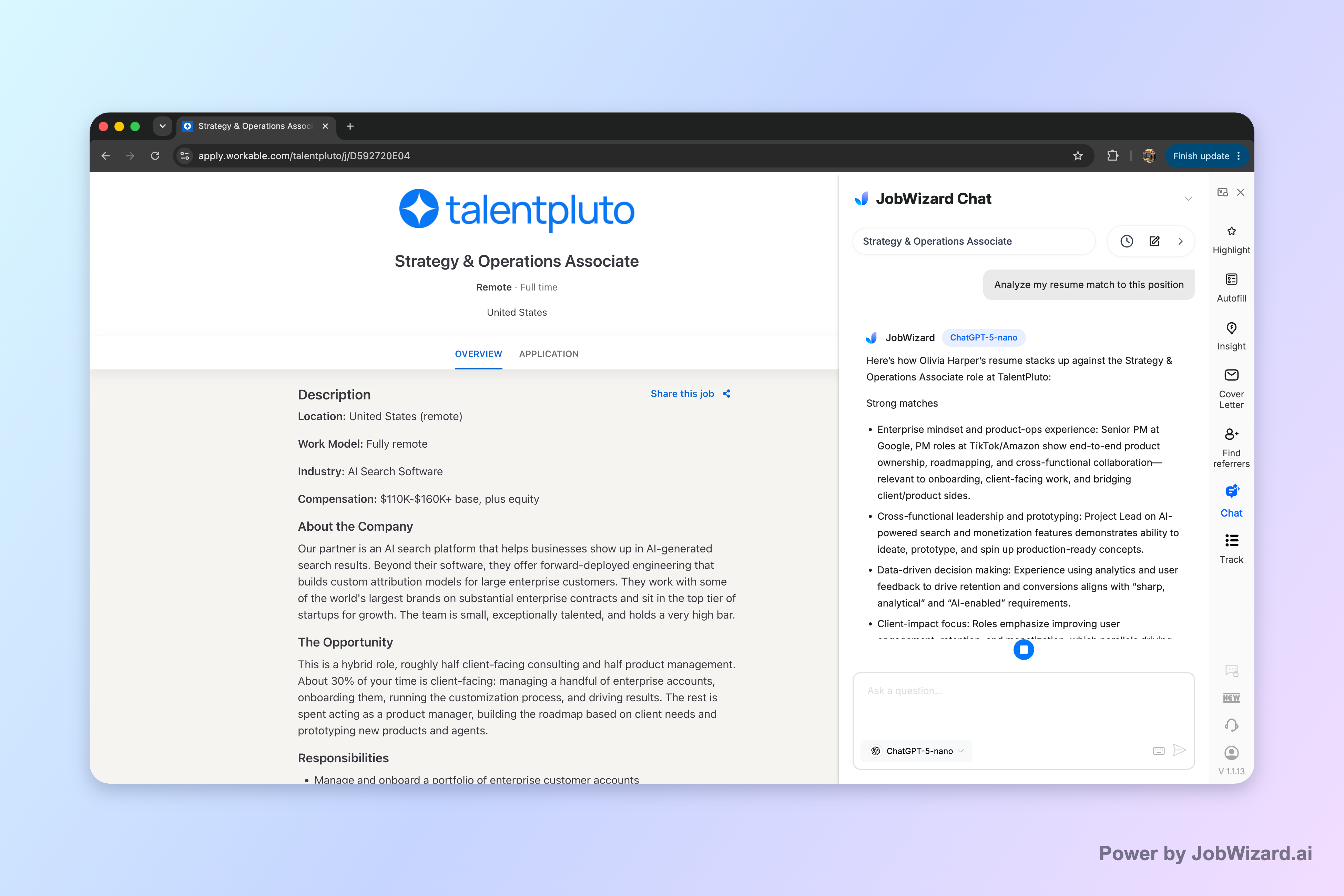
This is also where you can avoid generic answers. With JobWizard’s Career Chat, you can keep the current role in context and ask follow-up questions about your fit and application strategy without re-pasting the job description.
How to answer date available for employment without overpromising
Use your earliest realistic start date, then add one line of context. That’s the fastest path to a clear, professional response that HR can plan around.
Think of your availability answer as two parts: (1) the date or window you can commit to, and (2) a brief, neutral reason if you’re not starting immediately.
- Lead with the earliest start: “Available starting March 10” or “Available within two weeks.”
- Keep the reason short: “Following a standard notice period” (no extra drama).
- Offer coordination only if it’s true: “If needed, I can discuss alternative start timing.”
Plug-and-play scripts you can adapt
Pick the closest script and swap in your details. These are designed for job forms that ask for a single date or a short description.
- If you have a notice period: “Available starting [date] following my standard notice period.”
- If you can start soon but not immediately: “Available within [1–3] weeks (earliest: [date]).”
- If you’re between roles: “Available starting [date] (or immediately, if accurate).”
- If you need time for logistics: “Available starting [date], assuming background/process steps are completed.”
If you want more targeted wording for the exact form prompt you’re seeing, use our deeper guides: How to Answer “Date Available to Start” on an Application: Scripts for Timing, Notice, and Flexibility and When Are You Available to Start? A Practical Script for Confident “Start Date” Answers.
Answering “date available for employment” when you’re currently working
If you’re employed, your best answer is specific, calm, and aligned with notice. You don’t need to explain everything—HR just needs a workable timeline.
For most candidates, “currently working” translates to one of two realities: you can’t start until a certain date, or you can start within a predictable range depending on handoff timing.
Best wording for notice-period situations
State the earliest date you can start after notice. Then keep the sentence tight.
- Direct and safe: “Available starting [date] after my notice period.”
- With a scheduling-friendly close: “I’m available starting [date] and can coordinate onboarding timing with your team.”
- When you need flexibility: “Earliest availability is [date]; I can discuss alternative start timing depending on onboarding needs.”
Important: avoid implying you can jump earlier than you can. That’s how availability answers turn into follow-up headaches later.
What not to do
Don’t over-explain or contradict yourself. Keep the tone professional and consistent across forms and interviews.
- Don’t write “as soon as possible” if you can name a date.
- Don’t share internal HR details (“my manager won’t approve” or “they’re holding me back”).
- Don’t promise a date in one place and a window in another without reconciling it.
When you don’t know the exact date yet (and still need to apply)
You can be honest without leaving HR guessing. If you don’t know the exact day, provide the most accurate estimate and a clear next step for confirmation.
This scenario is common when your timeline depends on approvals, finishing projects, or final steps in another process. The key is to communicate probability, not wishful thinking.
Use an estimate + a confirmation moment
Give a target and tell HR when you’ll be able to confirm. Examples:
- Estimate anchored in time: “I expect to be available around [week/date]. I can confirm the exact start date by [day/milestone].”
- Window + follow-up: “I’m likely available within [timeframe]. I’ll update you with the exact date once my current commitments wrap up.”
- Conditional flexibility (only if true): “If onboarding can start on [date], I can align; otherwise, I’m available by [later date].”
If the application includes other HR-style questions (like compensation expectations or general availability), it helps to plan your answers as a set. Start with our broader application-question approach: How to Answer Job Application Questions: A Field-Tested Method for Confident, Consistent Responses.
Answering “date available for employment” during interviews and follow-ups
During interviews, repeat the same availability story—slightly more conversational. You’re still aiming for clarity, but you can add a cooperative tone.
Recruiters sometimes ask a follow-up question after your submission because they’re aligning schedules and staffing needs. When that happens, don’t introduce a new date. Use your earlier earliest-realistic start date and restate it confidently.
Interview follow-up script
Earliest date first, then a short reason. Try:
- Yes, and specific: “Yes—I’m available to start on [date]. My current notice period ends by then.”
- Earliest date + coordination: “My earliest start is [date]. If it helps, I’m flexible on onboarding timing and can adjust around your process.”
- If your start date could shift: “My target is [date]. I’ll confirm the exact day by [time], but I can plan around that timeframe.”
Follow-up email reply: keep it clean
If you need to reply by email, prioritize clarity and next steps. If your conversation moves forward, use a structure similar to our guidance on interview email replies: How to Answer to an Interview Email: A Reply-First Plan for Clear Next Steps.
For practical consistency, review your availability answer right before submitting. The fastest fix isn’t rewriting your whole application—it’s making sure every “date available” mention matches your earliest-realistic start.
Do this automatically with JobWizard
Skip the manual work — JobWizard's Smart Autofill handles this for you.
FAQ: How to answer date available for employment
These quick answers help you choose the right availability wording in common situations.
What should I write for “date available for employment” if I’m currently working?
If you’re currently employed, answer with the earliest realistic date plus a brief notice explanation (e.g., “I’m available starting [date] following a standard notice period.”). If you truly have limited wiggle room, keep it specific—then add that you can discuss options during the process.
Is it okay to say I’m available “immediately” on a job application?
Only say “immediately” if you can actually start right away. If your situation requires notice, use a date (or a short window) that’s honest (e.g., “Available within two weeks,” or “Available starting [date] after my notice period”).
How do I answer if I don’t know my exact start date yet?
If you don’t know yet, give the most accurate estimate you can and offer a follow-up. For example: “I expect to be available around [week/date]. I can confirm the exact start date after [brief reason].”
What if the recruiter asks a more specific start-date question after I submit my application?
Reply with the same approach—earliest realistic date first, then a short context line. For example: “Yes—I can start on [date]. I’ll have my notice period wrapped up by then, but I’m happy to coordinate if we need to adjust timing.”
How can I keep my availability answer consistent across application and interviews?
Use one internal “earliest realistic start date” and one “flexibility range.” Then mirror the same language on the form and later conversations (date first, brief notice context second), leaving room for coordination without contradicting yourself.
JobWizard usage shows how common this workflow is: 720,000+ applications submitted and 600,000+ autofill sessions run through JobWizard. The key is that autofill fills repetitive fields fast, while you review before submitting—so your availability and other specifics stay accurate.
Ready to nail your “date available for employment” answer consistently? Use JobWizard to autofill repetitive application fields quickly, then review every time—so your start date (and any timing notes you include) stays truthful and aligned with the role.
Frequently Asked Questions
Let AI answer these questions for you
JobWizard fills sponsorship, work-auth, and availability answers correctly on every application — free.