How Do Referrals Work? A Step-by-Step Guide to Getting the Right Person to Say Yes
Wondering how do referrals work? Learn the real process—from who can refer you to what they actually send—so your outreach sounds specific and credible.
Free Chrome extension
Find someone to refer you — automatically
JobWizard spots employees at your target companies who can refer you, right from the job page.
How do referrals work? They’re a human recommendation that starts with the right contact.
If you’re asking how do referrals work, the simplest answer is this: a current employee (or someone inside the company) recommends you because they can vouch for your fit. But the process is more specific—and more controllable—than most people realize.
In practice, referrals don’t replace your application. They usually improve your visibility at the top of the funnel by getting your name in front of the people managing the role. From there, hiring teams still evaluate your resume, experience, and communication like any other candidate.
What “referral” means (and what it doesn’t)
A job referral is a recommendation tied to a specific job opening. The referrer may submit your resume through an internal mechanism, forward a message internally, or simply encourage the hiring team to review your application—exact details vary by company.
Referrals are not a guarantee. Even when a referral is submitted, you still have to be a strong match and respond through whatever screening steps the employer uses.
Why referrals can matter in the first place
Hiring managers often have to triage many applicants. A referral can add trust and context because it comes from someone who knows the company culture—or has seen similar work—rather than from a random inbound application.
That said, the “trust” part depends on relevance. A referral that feels generic, late, or mismatched to the role is less likely to help.
Step-by-step: how a referral typically moves from “message” to “review.”
To understand how do referrals work end to end, think in steps. Most successful referral requests follow the same sequence: identify a good contact, ask clearly, provide context, then let the hiring process do its job.
- Pick the right role — Don’t request a referral for “a job.” Use a specific posting or target job title.
- Choose a referrer who fits — Look for someone connected to the function, team, or a meaningful shared context (including alumni or prior work alignment).
- Send a targeted outreach message — Include a truthful, specific reason you’re reaching out and what you’re hoping they’ll do.
- Make it easy to say yes — Provide a short “here’s why I’m a match” summary they can quickly skim.
- They decide whether to refer — Sometimes they forward your info; sometimes they encourage internal review. Either way, you’re not controlling their choice.
- You still complete the application — Many employers still require you to apply through the normal process (and you should review everything before submitting).
What a referrer usually needs from you
Employees get referral requests constantly. The referrer’s time matters, so the best requests reduce friction.
- Role fit: what part of your experience matches the job’s needs.
- Proof: 1–2 concrete accomplishments (numbers if you have them, but clarity matters more than volume).
- Clarity: why now and why this company/team.
- Truthfulness: do not exaggerate connections or experience.
What to avoid (because it weakens the referral)
Even a strong referrer can be hesitant if your ask feels like mass outreach. If you want referrals to work, your message must feel specific to them and the role.
- Vague requests: “I’d love a referral” without role details.
- Pressure: demanding answers or implying they must help.
- Incomplete context: forcing them to research everything about your background.
- Generic copy: the same template sent to multiple people.
How to request a referral without sounding spammy.
When you’re trying to understand how do referrals work, the request message is where you win or lose. Your goal is to make it easy for a referrer to decide, not to “convince” them like a sales pitch.
The strongest referral asks are brief, specific, and truthful. You don’t need a novel—you need enough context to justify why they’re helping.
Use this simple outreach structure
Follow this order so your referrer immediately understands (1) what you want and (2) why it makes sense for the role.
- 1 sentence: what role you’re targeting and where you found it.
- 1–2 sentences: why your background aligns with that role.
- 1 sentence: why you’re reaching out to them specifically.
- 1 sentence: a clear, low-pressure ask (what you’re requesting).
- Optional: offer a short summary/resume and a draft message they can review.
Example: a referral request that feels human
Here’s a concise example you can adapt (replace bracketed parts):
Subject/first line idea: “Role referral request: [Job Title] at [Company]”
“Hi [Name]—I’m applying for the [Job Title] role on [posting source]. Based on my experience in [1–2 relevant areas], I think I could contribute to [specific team goal or responsibility]. I’m reaching out because you’ve worked on [their relevant project/team], and I’d appreciate your perspective on whether I’d be a fit. If you’re open to it, would you consider referring me (or forwarding my info) for this position? If helpful, I can share a short summary of my background and a draft note you can review.”
Get help drafting—but personalize before you send
Some tools can organize potential referrers and help draft outreach. That can reduce the blank-page problem, but you’re still responsible for accuracy and specificity.
Referral Finder in JobWizard is designed to organize relevant employees by match type (including role and alumni context) and prepare an outreach draft you can review and personalize before contacting anyone.
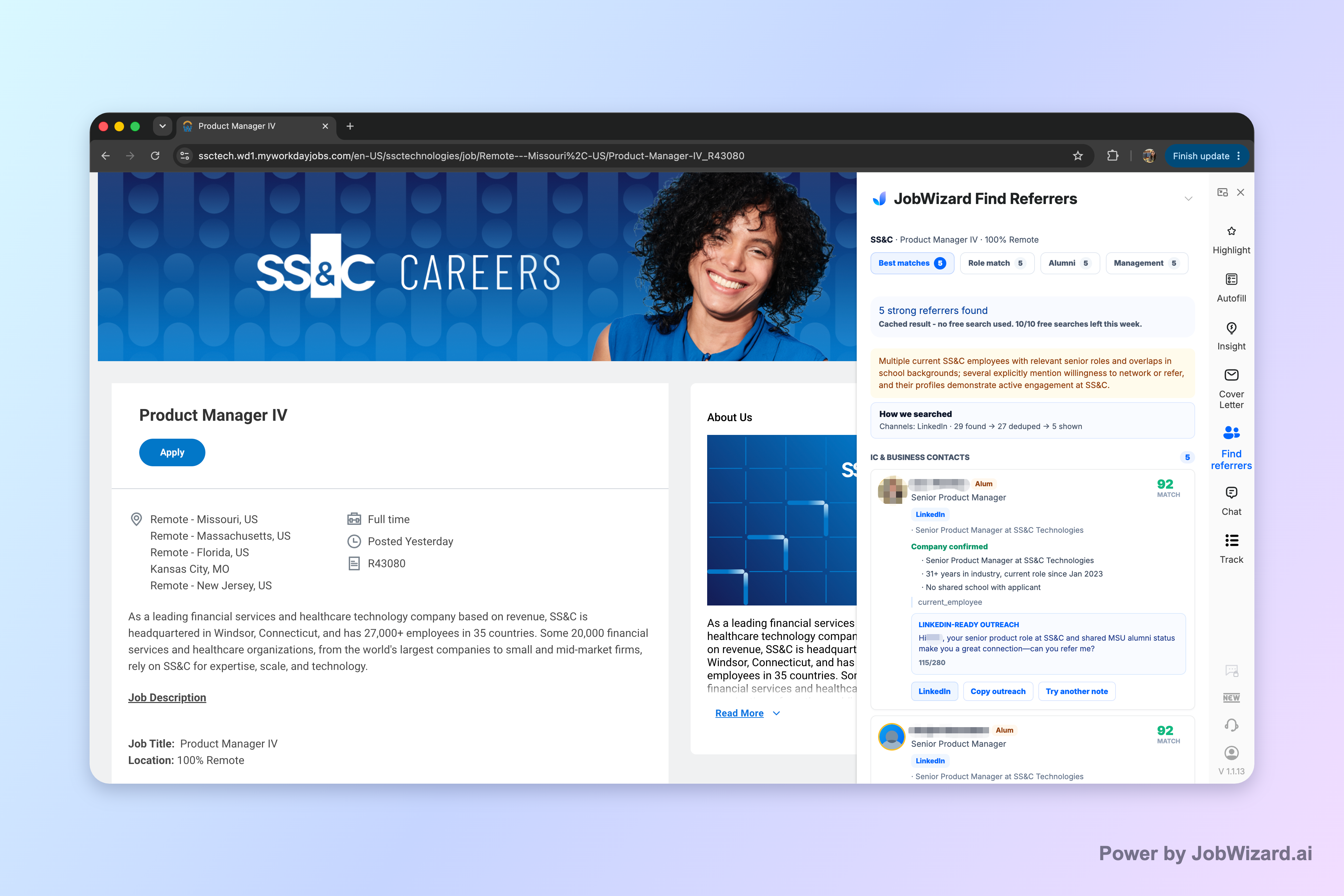
In other words, it supports the workflow—but you still choose whom to contact and you must add a truthful, specific reason for reaching out. You’re not outsourcing your judgment.
Finding the right people: how to choose a referrer who actually helps.
The difference between a referral that gets read and one that goes nowhere often comes down to who you ask and why you ask them.
Use a simple matching mindset: a great referrer is someone with a plausible connection to the role and a reason to believe your experience will translate.
Match types that usually work
- Team/function overlap: they work in the same functional area as the role.
- Role-adjacent experience: they’re familiar with the day-to-day skills the job requires.
- Shared context: alumni or other legitimate shared background that creates an honest bridge.
How Referral Finder supports this process
JobWizard’s Referral Finder organizes relevant employees by match type and prepares an outreach draft for you to review and personalize.
Important limitation: you should not assume the contact is accurate, responsive, or guaranteed to lead to a referral. You choose whom to contact, and you must add a truthful, specific reason for reaching out.
Internal reality check: “referral” workflows vary
Even if someone agrees to refer you, the mechanics depend on the company. Some organizations route referrals through a portal; others handle them via internal email or internal review. Either way, your job is still to submit a strong application and be ready for recruiter or hiring manager follow-up.
When to ask (timing that increases your odds)
Referrals tend to be most useful when they’re close enough to the hiring team actively reviewing that posting. A practical approach is to ask shortly after you identify the opening—and then follow up briefly if you don’t hear back. Keep it professional and brief.
Do this automatically with JobWizard
Skip the manual work — JobWizard's Smart Autofill handles this for you.
FAQ: How do referrals work at common stages of the hiring process?
How do referrals work in hiring—do recruiters always see them?
Referrals typically start with an employee (or sometimes a recruiter) forwarding your info or recommending you internally. Whether that leads to an interview depends on the employer’s workflow and the referral’s relevance to the role.
What should I say when I ask someone to refer me?
Ask with a specific reason you’re reaching out (what role you’re targeting and why it matches your background), then make it easy for them to help by offering a clear summary of your experience and a draft message they can review.
Do referrals guarantee I’ll get hired?
No. A referral can improve visibility, but it doesn’t guarantee an interview or offer. You still own your application materials and responses to screening steps.
How do I find the right person to request a referral from?
Start by identifying employees who have a natural connection to the role—same team, similar function, or shared context like alumni history. Then tailor your outreach so it’s clear you’re not sending a generic request.
Is it okay to ask for referrals on LinkedIn?
Yes, as long as your message is respectful, specific, and truthful. Keep your ask clear, avoid pressure, and provide enough context for them to decide whether they can genuinely support you.
Make referrals easier with the right outreach workflow.
If you want referrals that actually move your application forward, focus on two things: targeted outreach and easy-to-review context. JobWizard helps you do the front-end work with Referral Finder, which organizes relevant employees and drafts a message you can personalize.
Start by identifying 5–10 potential referrers for a specific posting, review the draft, and then send a truthful, role-specific ask. You’ll get better outcomes by treating referrals like relationship-driven outreach—not mass messaging.
- How to Network and Secure Job Referrals During the Hiring Off-Season for a Faster Offer
- Job Referral Letter Sample: A Ready-to-Copy Note for Requesting Referrals (That Recruiters Actually Read)
- How to Get a Referral at Any Company Without Connections
Ready to improve your referral outreach? Use JobWizard to organize potential referrers and draft a message you can personalize before you contact anyone.
Frequently Asked Questions
Find someone to refer you — automatically
JobWizard spots employees at your target companies who can refer you, right from the job page.