Accounts Payable Keywords: How to Match Job Descriptions, Get Noticed, and Apply Confidently
Learn the most useful accounts payable keywords to weave through your resume and application—then use JobWizard’s JD Highlights to map requirements before you apply.

Free Chrome extension
See your resume's match score for any job
JobWizard compares your resume to each job description and shows the exact keywords to add — free.
Why “accounts payable keywords” matter more than you think
When you search for AP roles, you’ll notice a pattern: every job posting is packed with specific terms—tools, processes, and responsibilities. Those terms are what recruiters and hiring teams use to quickly confirm fit. That’s why accounts payable keywords deserve a deliberate place in your resume and application, not just a casual sprinkle. The goal isn’t to game an ATS—it’s to make your experience immediately recognizable to the person reviewing the requirements.
In practice, the easiest way to fail isn’t adding too few keywords—it’s missing the right ones. If your resume only lists “accounts payable” but the posting repeatedly emphasizes invoice matching, vendor management, payment runs, or month-end close support, you can look less relevant than you are. The fix is a workflow: identify the keywords the job truly cares about, then map your experience to those requirements in a way that’s accurate and specific.
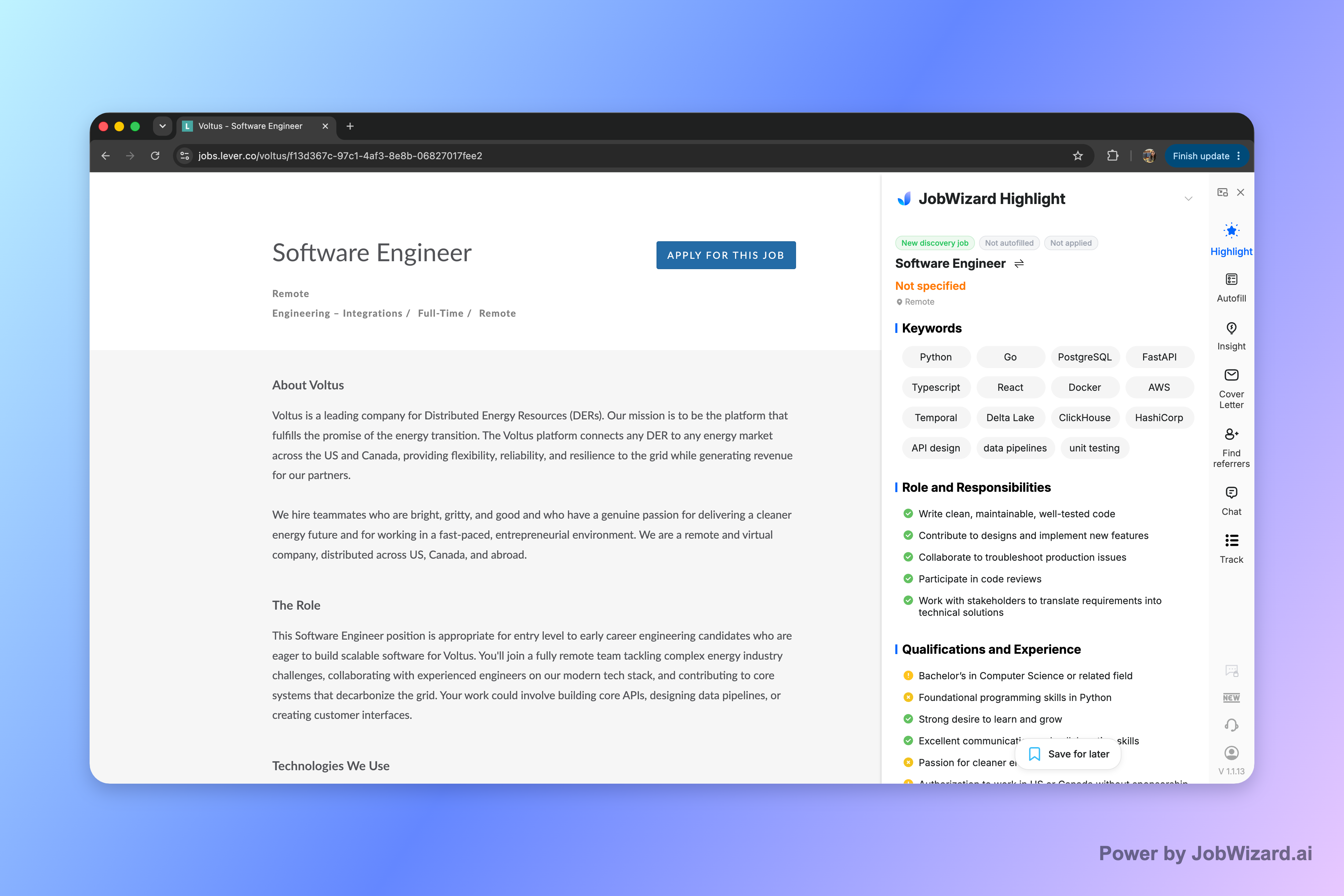
If the job description is long, it’s easy to skim past the exact responsibilities and qualifications that matter. JobWizard’s JD Highlights helps you turn a job description into a structured view so you can review the requirements more systematically—without guessing what to prioritize. (Remember: highlighted keywords don’t predict ATS decisions or hiring outcomes; they’re a reading aid.)
How to find the right accounts payable keywords inside any job posting
Start by treating each job posting like a checklist. You’re looking for three buckets of information that directly translate into keywords and phrases you should use:
- Core responsibilities (what you’d do day to day): invoice processing, vendor correspondence, payment processing, approval workflows, exception handling, month-end activities.
- Qualifications (what you must have): experience level, accounting fundamentals, attention to detail, process improvement, ability to work with cross-functional teams.
- Systems/process language (what gets named repeatedly): AP automation tools, ERP, invoice workflow states, GL coding, audit/support documentation, reconciliation methods.
Common accounts payable keywords (organized by workflow)
Below are keyword examples you’ll frequently see in accounts payable and similar finance operations postings. Use them as a guide, then verify the wording in your target job description and adapt your resume bullets accordingly.
| AP workflow area | Keyword examples to look for | Where you can use it |
|---|---|---|
| Invoice intake & processing | invoice processing, AP invoice, invoice workflow, invoice review, invoice exceptions | Resume bullets under AP experience; “Skills” or “Core competencies” |
| Matching & approvals | invoice matching, 2-way/3-way match, purchase order (PO), approvals, approval workflow | Bullet points showing your matching and approval steps; cover letter details |
| Vendor management | vendor inquiries, vendor statements, vendor communications, PO/vendor discrepancies | Bullets describing how you resolved issues and maintained vendor relationships |
| Payments & payment runs | payment runs, payment processing, check & ACH, payment scheduling | Bullets describing your role in on-time payments and run preparation |
| Accounting & reconciliation | AP/GL, general ledger coding, account reconciliation, clearing accounts, accruals support | Bullets tying AP work to accounting outputs; “Month-end” bullet lines |
| Month-end & close support | month-end close, accrual support, aging reports support, audit support | Resume bullets; targeted “Close/Reporting” section |
| Compliance & documentation | SOX controls (if mentioned), documentation, audit trail, invoice approvals evidence | Bullets emphasizing accuracy, controls, and organized records |
Use exact wording when it’s truthful
A strong resume doesn’t just include AP keywords—it matches the job’s vocabulary. That means:
- If the posting says “invoice exceptions”, and you truly resolved exceptions, use the phrase.
- If it says “vendor inquiries”, and you responded to vendor questions, describe your workflow using similar language.
- If it lists “AP/GL coding”, and you coded invoices, connect your responsibilities directly to GL coding or accounting categories.
When you’re unsure whether you should use the phrasing, default to describing your process in your own words—but keep the meaning aligned. The key is not copying; it’s matching meaning with recognizable terms.
Turn keyword research into resume bullets that feel specific
Many applicants treat accounts payable keywords like a checklist: add a few terms, move on. The difference between “keywords present” and “keywords convincing” is proof. Your bullets should describe what you did, how you did it, and what you ensured (accuracy, timeliness, audit-ready documentation, correct coding, clean approvals).
Bullet templates for accounts payable keywords
Use these structures to build bullets that naturally incorporate AP keywords while staying credible.
- Invoice processing bullet: “Processed AP invoices using [workflow/tool], ensuring proper review, documentation, and exception handling for [type/volume if known].”
- Matching/approvals bullet: “Verified invoice matching (e.g., 2-way/3-way) against POs/receipts and supported approval workflow for timely payment.”
- Vendor inquiry bullet: “Resolved vendor inquiries by investigating discrepancies, coordinating with internal stakeholders, and updating records to maintain accurate AP status.”
- Payment run bullet: “Prepared for payment runs by confirming invoice status/approvals and supporting on-time payment scheduling.”
- Month-end/close bullet: “Supported month-end close activities by reconciling AP-related items and preparing documentation for reporting and audit needs.”
Concrete example: rewriting a generic AP bullet
Here’s the difference between a vague resume line and one that uses accounts payable keywords in context.
Generic (too broad): “Handled accounts payable invoices and assisted with payments.”
More keyword-aligned (still honest, more specific): “Processed AP invoices through the invoice workflow, reviewed for completeness, resolved invoice exceptions, and supported approval steps to help ensure accurate payment processing.”
Notice what changed: you can now “see” the workflow. That’s what keywords are supposed to communicate—your experience mapped to the job’s responsibilities.
Where to place accounts payable keywords on your resume
- Experience section: add keywords inside bullets for the tasks you truly performed (invoice processing, approvals, vendor inquiries, payment runs, reconciliation, month-end close support).
- Skills section: use keyword phrases that represent your real competencies (e.g., invoice matching, AP/GL coding, reconciliation, vendor communication, audit documentation).
- Summary (optional): a 2–3 line statement that mirrors the role’s focus using the top accounts payable keywords from the posting.
Tip: if the job description emphasizes cross-functional work (like coordinating with purchasing, receiving, or accounting), include that language too. A posting’s “soft” qualifiers often come with hard requirements—like documentation, accuracy standards, and turnaround expectations.
Apply confidently: map requirements before you submit
Keyword matching doesn’t end at the resume. Application forms and questionnaires often ask for the same responsibilities and qualifications—sometimes in different wording. A reliable approach is to review the job description requirements and then apply intentionally.
Use JD Highlights to structure the reading step
JobWizard’s JD Highlights is designed to help you organize a job description into keywords, role responsibilities, and qualifications so you can review the requirements more systematically. That makes it easier to:
- Confirm you have strong evidence for the responsibilities the posting prioritizes.
- Spot qualifications you might otherwise overlook in a long list.
- Refine the accounts payable keywords you want to emphasize in your application materials.
Again, limitations matter: do not treat highlighted keywords as predictors of ATS decisions or hiring outcomes. They’re there to help you read and prioritize the posting.
Autofill + review-before-submit (what to trust vs. what to check)
JobWizard can fill repetitive fields quickly while you review before submitting. In our aggregated usage data, JobWizard has supported 720,000+ applications submitted and 600,000+ autofill sessions. Autofil l sessions typically fill ~18 repetitive fields per application (often 11–23). These fields usually cover the “boilerplate” parts of an application, while you retain control over content that requires your judgment.
This matters for accounts payable roles because the form responses you should personalize often include sponsorship / salary / EEO / custom questions. The right workflow is: let repetitive fields get filled fast, then carefully review the content tied to your experience and the requirements from the posting before you submit.
Key idea: use autofill as a time-saver for repetitive fields—not as a substitute for your judgment on responsibilities, qualifications, and any application-specific questions.
How to translate posting requirements into application responses
When a form asks about experience, use the posting’s language as a guide:
- If the posting lists invoice matching, describe your role in matching and approvals—even if your system name differs.
- If it emphasizes reconciliation or AP/GL, connect your work to reconciliation processes and accounting coordination.
- If it calls out vendor inquiries, summarize your approach to discrepancy resolution and communication.
Then do one final check: does each answer reflect the accounts payable keywords that appeared in the responsibilities and qualifications sections? If not, revise.
Do this automatically with JobWizard
Skip the manual work — JobWizard's Smart Autofill handles this for you.
Accounts payable keywords: FAQ for job seekers targeting AP roles
What are the most important accounts payable keywords to include on a resume?
Focus on keywords that mirror what the job description emphasizes—commonly invoice processing, AP/GL, vendor management, invoice matching (2-way/3-way), payment runs, approvals, and month-end close support. Use the exact phrasing from the posting where it fits your experience.
Should I copy the job description word-for-word into my application?
No. Use the accounts payable keywords as prompts to phrase your own experience. Aim for clarity and accuracy: match responsibilities and tools you truly used, and keep sponsorship-specific items (salary, EEO, custom questions) for your review before submitting.
How do I avoid missing requirements when a job posting is long?
Start by breaking the posting into role responsibilities, qualifications, and requirement keywords. JobWizard’s JD Highlights organizes a job description so you can review the requirements more systematically before you apply.
What if my resume doesn’t exactly match the accounts payable keywords in the posting?
Translate your related work into the language of the posting. For example, if you handled “invoice approvals,” describe your approval workflow; if you did reconciliation, connect it to AP/GL or vendor statements. Don’t claim systems or tasks you didn’t perform—reword what you did.
How should I use accounts payable keywords during the application process?
Use them at three points: (1) resume bullets for tasks you performed, (2) a concise summary/targeted skills section aligned to the posting, and (3) application responses where the form asks for responsibilities or qualifications. Then review all autofilled or AI-generated content before submitting.
Next step: apply with a keyword map you can defend
If you take one action before applying, make it this: open the target AP job posting and use JobWizard’s JD Highlights to organize the job description into keywords, responsibilities, and qualifications. Then review the requirements systematically and tailor your accounts payable keywords so your resume and application responses reflect the role’s real priorities. That’s how you apply with confidence—because you didn’t guess what mattered.
CTA: Open the role you want and run JD Highlights in JobWizard. Review the responsibilities, qualifications, and keyword list—then submit only after you’ve confirmed every important detail is accurate.
Frequently Asked Questions
See your resume's match score for any job
JobWizard compares your resume to each job description and shows the exact keywords to add — free.