
Simplify vs Teal: How to Choose an Autofill-Style Job Application Tool Without Losing Control
Simplify vs teal comes down to workflow control: how autofill fills repetitive fields while you review final answers before submitting.

Free Chrome extension
Autofill your next job application
JobWizard is a free Chrome extension that fills applications, tracks statuses, and optimizes your resume.
If you’re comparing simplify vs teal, the most useful way to decide isn’t by ads about speed—it’s by whether the tool’s autofill workflow keeps you in control of what gets submitted.
Autofill-style job application tools are designed to fill the repetitive parts of an application form quickly, but you still need to review the populated content and submit yourself. The difference between “helpful automation” and “risky automation” is usually how the tool handles review, missing required fields, and custom questions.
What “autofill” should mean in simplify vs teal
Autofill should be a field-filling assistant—not a black box that submits your application without your final check.
In a control-first approach, the workflow looks like this: the tool uses your saved profile/resume information to fill detected fields on supported application pages. Then it presents the populated fields so you can confirm or edit before submission. If a required field still needs attention, the tool should help you find and complete the matching question yourself.
- Repetitive fields: autofill targets common profile and form entries that appear across many applications.
- User-specific answers: you should still decide on anything that could vary by application (role details, eligibility, salary expectations, custom questions).
- Required-field gaps: a good tool flags what still needs input so you can jump in and finish accurately.
That’s the practical lens for simplify vs teal: not “Which one can fill faster?” but “Which one helps me review every important answer before I submit?”
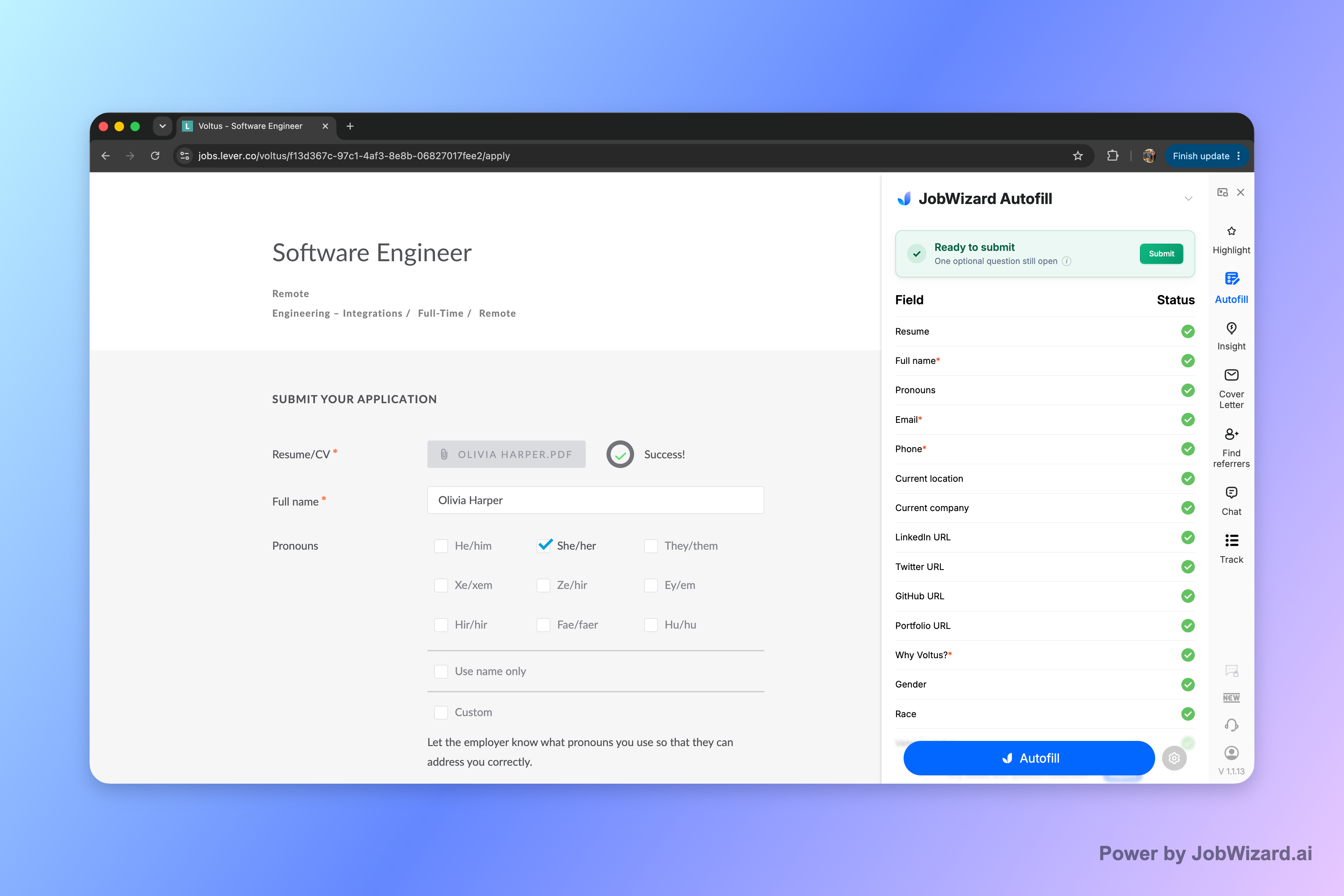
How to compare Simplify and Teal using a control-first checklist
Use the same review checklist on both tools so you’re comparing workflow control, not marketing.
Even when two apps both claim “autofill,” they can differ in how well they support your review process and how they handle missing or uncertain fields. Here’s what to evaluate before you trust any tool with your applications.
- Review-first flow: after autofill, can you clearly see what was filled so you can confirm accuracy before submitting?
- Missing required fields: if something can’t be completed, does the tool help you identify what needs attention and move you to the matching question?
- Custom questions coverage: do you still have to answer any sponsorship/eligibility, salary, EEO, or job-specific prompts yourself?
- Platform fit: does it work well on the application systems you actually use (for many applicants, Workday is a common target)?
To ground this in real usage patterns: across applications submitted with JobWizard, Workday is where it saves the most time, and many autofill sessions are spent on repetitive fields while the user reviews before submitting. Specifically, JobWizard autofills an average of ~18 repetitive fields per application (typically 11–23), and of applications submitted through it, ~65% are on Workday, ~19% Greenhouse, ~12% Ashby, ~4% Lever.
Translation: you should expect autofill to accelerate the form parts you repeat, while you remain responsible for the final, application-specific answers.
Common mistakes when people choose simplify vs teal for “speed”
The biggest failure mode is not autofill—it’s skipping the review that’s required before you submit.
When people optimize for “auto-apply vibes,” they often under-check the fields that don’t generalize across applications. Those are exactly the areas that can cause misalignment with the job or create compliance issues.
- Answer drift: custom questions (eligibility, role preferences, or job-specific prompts) can be easy to miss if you only glance at the filled form.
- Salary/expectations mismatch: these fields should match the specific posting—not just your general profile.
- EEO and policy selections: ensure the selections shown are the ones you intend for that application.
- Unfilled required items: required fields might need manual input even if autofill completed most of the form.
The safest mindset is: autofill is for repetitive form completion; your review is for correctness. In that framing, simplify vs teal is mainly about how the tool supports your final checks—not whether it “feels” fast.
Which tool should you pick? (A decision shortcut for simplify vs teal)
Pick the option that makes review and required-field completion easiest—that’s the real differentiator for most applicants.
If your priority is maximum control and you want an autofill workflow that fills detected fields while keeping submission in your hands, use a trial run on your next application and compare the experience side-by-side.
Here’s a straightforward decision shortcut:
| What you care about | What to look for |
|---|---|
| Control | Clear populated fields with a review-before-submit approach (you submit yourself). |
| Accuracy for custom questions | Everything that can’t be inferred should still require your review and edits. |
| Handling required gaps | Ability to identify what still needs attention and help you jump to the matching question. |
| Time saved on common platforms | Strong support for the application systems you see most often (Workday is a major one for many job seekers). |
For your next step, try an autofill workflow on a real posting and commit to the same habit every time: review every answer before submitting. If you want a control-first approach to autofill and review, you can try JobWizard’s Autofill on your next application and focus on verifying every filled field before you hit submit.
Do this automatically with JobWizard
Skip the manual work — JobWizard's Smart Autofill handles this for you. On these platforms: JobWizard vs Simplify, JobWizard vs Teal.
FAQ: Simplify vs Teal
Is Simplify vs Teal really about “auto-apply,” or is it more about autofilling forms?
It’s mostly about autofilling application form fields fast, then having you review what was filled before you submit. Any tool that fills repetitive fields still requires your final check on custom answers.
What should I verify after any autofill tool populates an application?
Check the fields that can’t be safely inferred—your sponsorship/eligibility answers, salary expectations, EEO-related selections, and any custom questions. Also confirm the filled values match the exact role and company you’re applying to.
Does “autofill” mean the tool submits applications automatically?
No—autofill is about filling detected fields on the page. In a control-first workflow, you remain the one who submits after reviewing the populated fields.
How do I handle a required field that autofill can’t complete?
Look for workflows that identify what’s still needing attention so you can jump directly to the matching question and complete it yourself. The goal is fast filling for repetitive fields, not blind completion.
Where does autofill tend to save the most time?
Autofill usually helps most with the repetitive parts of applications—especially the standard profile and form fields. It tends to save more time on platforms like Workday, while you still review the user-specific and policy-style questions before submitting.
Frequently Asked Questions
Autofill your next job application
JobWizard is a free Chrome extension that fills applications, tracks statuses, and optimizes your resume.