Keywords for Accounting Jobs: The JD-Driven List That Gets You Noticed
Learn how to build a targeted set of keywords for accounting jobs by extracting requirements directly from each job description, then matching them to your resume and application answers.

Free Chrome extension
See your resume's match score for any job
JobWizard compares your resume to each job description and shows the exact keywords to add — free.
You’re not alone if it feels like the job search for keywords for accounting jobs is a moving target. Titles change, job descriptions get long, and “requirements” can hide in plain sight. The result: you either over-guess what to include—or you miss the exact terms an employer expects to see.
In practice, the fastest path to accurate keywords is to build your list directly from each job description. That means extracting keywords for the role’s responsibilities and qualifications, then reviewing the requirements in a structured way before you apply.
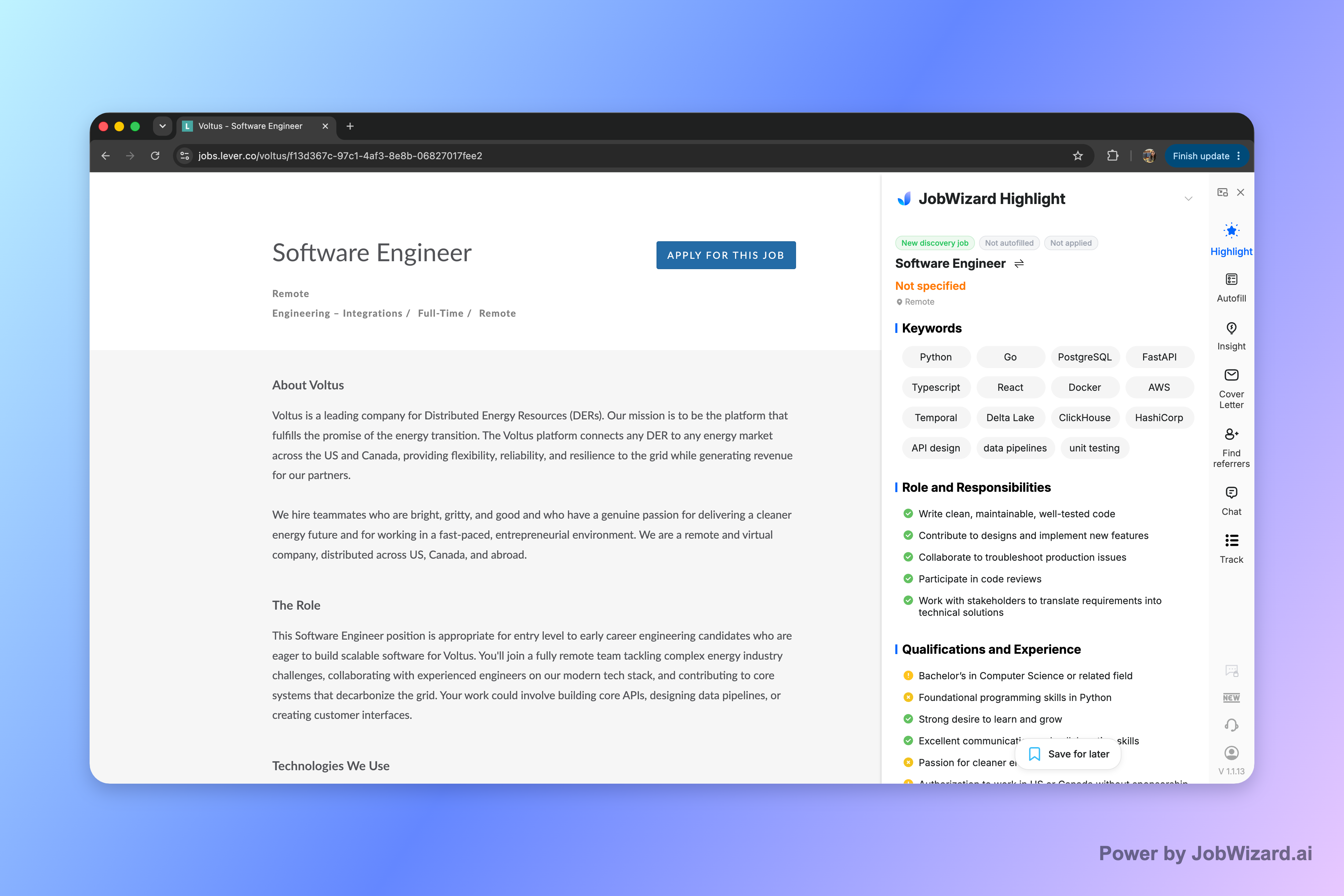
JobWizard JD Highlights can organize a job description into keywords, role responsibilities, and qualifications so you can review the requirements more systematically.
Start with JD extraction: turn a long accounting posting into a keyword shortlist
Most applicants try to “research the keywords” and then hope it matches the role. Instead, reverse the process:
- Read the job description like a checklist. Don’t start with the title—start with what the team says they need done.
- Pull out repeated themes. Look for responsibilities and qualifications that show up more than once, or that appear in both the “responsibilities” and “requirements” sections.
- Convert themes into keywords. Turn phrases into the terms you can realistically use on your resume and in application answers (for example: “month-end close,” “bank reconciliations,” “journal entries,” “variance analysis,” “SOX compliance,” “GAAP”).
- Keep your shortlist role-specific. A “general accounting” keyword list is rarely the same as a “reconciliation-heavy” or “audit-support” keyword list.
When you do this consistently, your keywords for accounting jobs become evidence-based: they’re taken from the employer’s language, tied to the role’s responsibilities, and connected to the qualifications they claim matter.
Accounting job keyword categories you can reliably reuse (and what to avoid)
To make keyword selection easier, group your accounting terms into categories. Use the job description to decide which categories apply to that posting. Below are common keyword categories that frequently appear across accounting roles.
1) Core accounting operations keywords
- Month-end close (or “close process”)
- General ledger (GL)
- Journal entries
- Reconciliations (bank, balance sheet, subledger)
- Accounts payable (AP) / accounts receivable (AR)
- Accruals, prepaid expenses, amortization
- Trial balance
- Financial statement preparation / support
2) Reporting, analysis, and compliance keywords
- GAAP / IFRS
- Financial reporting
- Variance analysis
- Budgeting support (sometimes appears as “forecast” or “rolling forecast”)
- Internal controls
- SOX / Sarbanes-Oxley (if mentioned)
- Audit support (internal or external)
3) Tax and payroll-adjacent keywords (only when relevant)
- Tax compliance
- Sales and use tax
- Income tax provision (wording varies)
- 1099s / W-9s
- Payroll accounting (if the role truly touches payroll)
4) Tools and systems keywords
- Excel (often appears as formulas, pivot tables, lookups)
- Accounting software (general category terms may include “ERP”)
- Specific systems named in the posting (use the exact system name if provided)
- Reporting tools mentioned (if the job names them)
What to avoid
- Keyword stuffing: repeating every term you can find can make your resume sound unnatural—and may still miss the priorities of the role.
- Irrelevant categories: if the posting doesn’t mention tax or payroll, don’t pad those keywords into your bullets.
- Mismatch with your experience: only use keywords that reflect what you’ve actually done or can credibly explain.
Important: JD-based keyword matching can improve relevance, but it does not guarantee ATS or hiring outcomes. Treat keywords as alignment—not a prediction.
Build a “keyword-to-proof” workflow for each application
If you want keywords for accounting jobs that actually help, pair each keyword with proof you can reference quickly. Here’s a workflow you can run for every role you apply to.
Step 1: Make a two-column table from the job description
Create a small list with:
- Keyword (employer language)
- Your proof (your bullet or example)
Example for an accounting role emphasizing month-end:
| Keyword from job description | Your proof you can reference |
|---|---|
| Month-end close | “Supported month-end close by preparing journal entries and ensuring reconciliations were completed before reporting.” |
| Balance sheet reconciliations | “Performed balance sheet reconciliations for assigned accounts and investigated variances to resolve discrepancies.” |
| General ledger (GL) | “Maintained GL accuracy by reviewing postings, validating account balances, and correcting errors.” |
Step 2: Use keywords in the right places
Different parts of the application serve different purposes. Aim for clarity and consistency.
- Resume bullets: use keywords where they describe your actions and outcomes in plain language.
- Skills section: list relevant tools/competencies that match the posting. Keep it focused to the role.
- Cover letter: don’t just repeat keywords—connect them to one short experience.
- Application fields (custom questions, etc.): mirror the concepts the job asks for, using your own wording while incorporating the same terminology.
Step 3: Prioritize what matters most in the responsibilities
Accounting roles often differentiate based on what’s emphasized:
- Reconciliation-heavy roles: prioritize “reconciliations,” “investigate variances,” and “accuracy/controls.”
- Close and reporting roles: prioritize “month-end close,” “financial statements,” and “journal entries.”
- Audit support roles: prioritize “audit support,” “documentation,” and “internal controls.”
- Tax roles: prioritize “tax compliance” and whatever jurisdiction and compliance language the job uses.
Step 4: Quick consistency check before you submit
Before applying, scan your materials and ask:
- Do my bullets include the employer’s responsibility keywords (not just generic accounting terms)?
- Do I reflect the qualifications they listed (or can I explain them clearly)?
- Is the tone professional and specific—without sounding like I copied the posting?
This is also where tooling can help with organization. JobWizard JD Highlights can structure keywords, responsibilities, and qualifications from a job description so you can review the requirements more systematically—without losing track of what matters.
Examples: keyword sets for common accounting job types
Below are example keyword sets you can adapt. Use them as starting points, then validate them against the specific posting you’re applying to. These lists are organized by role emphasis so you can choose what to include.
Example A: Accounting Associate (month-end + reconciliations)
- Month-end close
- General ledger (GL)
- Journal entries
- Balance sheet reconciliations
- Variance investigation
- Financial statement support
- Excel
Example B: Staff Accountant (reporting + controls + audit support)
- Financial reporting
- GAAP
- Internal controls
- SOX (if mentioned)
- Audit support
- Documentation
- Excel
Example C: AP/AR Accountant (transaction processing + accuracy)
- Accounts payable (AP)
- Accounts receivable (AR)
- Invoice processing
- Reconciliations
- Payment/application posting
- General ledger (GL)
- Reporting support
Example D: Tax-focused role (compliance + forms)
- Tax compliance
- Income tax provision (if mentioned)
- Sales and use tax (if mentioned)
- 1099/W-9 (if mentioned)
- Documentation
- Attention to detail
For each example, the “right” set of keywords for accounting jobs depends on the posting’s responsibilities and qualifications. If the job description names a specific system or asks for a specific compliance area, prioritize those exact terms.
Do this automatically with JobWizard
Skip the manual work — JobWizard's Match Score handles this for you.
Accountability: how to review your keyword strategy without over-optimizing
It’s easy to make keyword matching a full-time job. Instead, keep it measurable and lightweight:
Use the posting language as your “source of truth”
Your keyword list should look like the job description—not like a generic list from the internet. If a keyword doesn’t appear (or isn’t clearly implied) in the employer’s requirements, treat it as optional.
Don’t confuse “matching terms” with “matching priorities”
Two roles can both contain the words “reconciliation” and “Excel,” but one may prioritize “variance investigation” and the other may prioritize “month-end close.” Your bullets should reflect the responsibilities most central to the posting.
Keep your application process human
Keyword alignment helps you speak to the employer’s needs more clearly, but you still need to review what you’re sending and submit yourself. Tools that streamline repetitive fields should be paired with your final review—especially for sponsor/salary/EEO/custom question content.
As you get more consistent, you’ll spend less time guessing and more time tailoring. JobWizard has supported large-scale use of workflow automation for applications and review-before-submit: 720,000+ applications submitted and 600,000+ autofill sessions run through JobWizard, with an average of ~18 repetitive fields filled per application. Workday is where it saves the most time (about ~65% of submitted applications on Workday), followed by Greenhouse (~19%), Ashby (~12%), and Lever (~4%). These stats reflect autofill + review-before-submit for repetitive fields, with users reviewing and submitting themselves.
That kind of workflow helps you focus your energy on the part that matters for keywords: reviewing each job description, selecting role-relevant keywords for accounting jobs, and ensuring your experience statements truly match what the employer is asking for.
Ready to tailor faster with JD structure?
Open the target role and use JobWizard JD Highlights to review the job description’s keywords, responsibilities, and qualifications in a structured view—then use that shortlist to tailor your resume bullets and application answers to the role you actually want.
How do I choose the right keywords for accounting jobs without guessing?
Use each job’s job description as your source of truth: identify the repeated skills, responsibilities, qualifications, and tools mentioned, then build a keyword shortlist that you can verify against what the employer actually asks for.
Should I include every accounting keyword I see in the job post?
No—use a focused set. Prioritize keywords tied to core responsibilities (what you’d do daily) and must-have qualifications (what you’re required to have). Keep wording natural and avoid keyword stuffing.
Does keyword matching guarantee my application will pass ATS?
Keyword matching can improve alignment, but it does not guarantee ATS or hiring outcomes. Treat keywords as a way to make your resume and application answers clearly relevant to the role.
What are good keywords for accounting jobs if the title is vague (e.g., “Accounting Associate”)?
Start with the responsibilities and requirements: common categories include month-end close, reconciliations, general ledger, accounts payable/receivable, journal entries, SOX/compliance, audits, and tools like Excel. Then confirm which of these the posting specifically emphasizes.
How should I use keywords in my resume versus cover letter or application fields?
Resume: mirror role-relevant tools and responsibilities in your bullets and skills section. Cover letter: explain one or two experiences using the same concepts. Application fields: answer custom questions in your own words while including the relevant terms the job description uses.
CTA: Want to build a job-specific keyword list faster? Open the accounting job you’re targeting, review its responsibilities and qualifications with JobWizard JD Highlights, and tailor your resume and answers around the exact keywords for accounting jobs the posting emphasizes.
Frequently Asked Questions
See your resume's match score for any job
JobWizard compares your resume to each job description and shows the exact keywords to add — free.