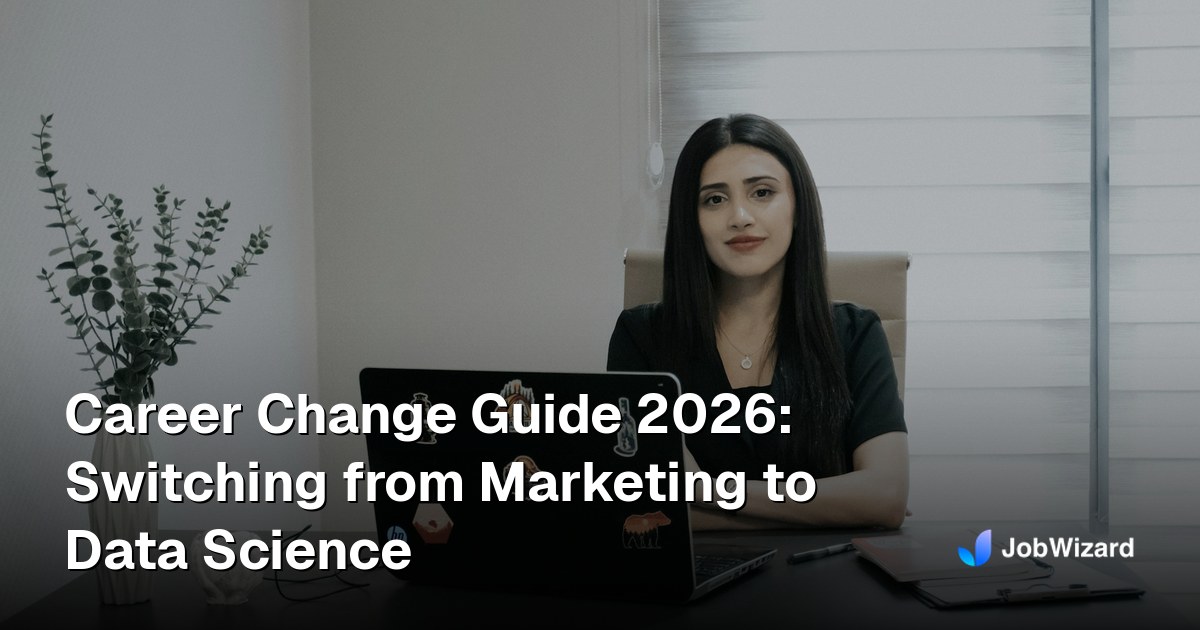
Career Change Guide 2026: Switching from Marketing to Data Science
Discover a step‑by‑step roadmap for marketing pros transitioning to data science in 2026. Upskill, revamp your resume, and land interviews....
Free Chrome extension
Autofill your next job application
JobWizard is a free Chrome extension that fills applications, tracks statuses, and optimizes your resume.
Career Change Guide 2026: Switching from Marketing to Data Science
In this Career Change Guide 2026: Switching from Marketing to Data Science, we’ll walk you through every step you need to take to turn your marketing background into a data science career. Whether you’re looking to upskill, rewrite your resume, or navigate modern ATS systems, this guide shows you how to apply faster, get noticed, and land interviews in 2026. If you’re ready to make the jump, keep reading – we’ll give you the practical tools and insider tips that will keep you ahead of the competition.
1. Why Data Science Is a Great Fit for Marketing Professionals
Marketing and data science share a common language: data. In 2026, brands are leaning more on predictive analytics to guide campaigns, personalize content, and measure ROI. Your experience with customer segmentation, campaign tracking, and performance dashboards already gives you a head start. By adding data science skills, you’ll transform insights into actionable strategy and open doors to higher‑paying roles that value analytical rigor.
Tip: Highlight your existing data‑driven achievements on your LinkedIn and résumé before you even learn new tools. Recruiters love seeing proven metrics.
2. Building a Data‑Ready Skill Set: What You Need to Learn
Creating a marketing to data science career roadmap means focusing on three pillars: programming, statistics, and domain knowledge. Below is a step‑by‑step path you can follow in 2026, starting with the basics and moving to advanced techniques.
- Python & R Basics – Start with beginner courses on Coursera or Udacity. Aim for 4–6 weeks of practice coding daily.
- Statistical Foundations – Master hypothesis testing, regression, and probability. Use Khan Academy or MIT OpenCourseWare for interactive lessons.
- Data Manipulation & Visualization – Learn Pandas, NumPy, and Matplotlib or Seaborn to clean and present data.
- Machine Learning Basics – Explore linear regression, decision trees, and clustering on platforms like Kaggle.
- Business Analytics & A/B Testing – Tie your new skills back to marketing by conducting real‑world experiments.
- Advanced Topics (Optional) – Deep learning, NLP, or reinforcement learning if you’re aiming for a data‑science research role.
Remember, the goal isn’t to master every tool at once. Instead, build a portfolio that showcases real‑world projects that combine marketing insights with data science techniques. This demonstrates both technical competence and business relevance.
3. Translating Your Marketing Experience into Data Science Value
When you’re ready to apply for data science roles, recruiters will want to see how your marketing background adds value to the team. Use the how to showcase marketing analytics in a data science resume approach to bridge the gap.
- Quantify Campaign Results – Replace generic phrases with data: “Increased lead conversion by 18% through targeted A/B testing.”
- Emphasize Analytical Tools – Highlight experience with Google Analytics, Tableau, or Adobe Analytics, and link these to your new Python scripts.
- Showcase Cross‑Functional Projects – Describe collaborations with product or sales teams where data informed strategy.
- Include a “Data Projects” Section – List Kaggle notebooks, GitHub repos, or internal dashboards you’ve built.
By aligning your past successes with data‑science outcomes, you position yourself as a candidate who can “think quantitatively” and “drive decisions with evidence.” Recruiters will see you as a bridge between marketing and data teams, a highly coveted skill set in 2026.
4. Applying for Data Science Roles: Mastering ATS and Cover Letters
The modern hiring process is heavily filtered by Applicant Tracking Systems (ATS) like Greenhouse, Lever, and iCIMS. In 2026, the average applicant spends 3–5 minutes on an ATS before a human sees the resume. You need a data science resume optimization strategy to survive the first filter.
Step 1: Use a Chrome Extension That Detects ATS Forms
Enter JobWizard – a Chrome extension that auto‑detects ATS fields and fills them using your curated résumé data. With JobWizard’s autofill feature, you’ll skip repetitive form‑filling and reduce errors that could disqualify you.
Step 2: Leverage the Match Score
JobWizard’s match score compares your résumé against the job description, highlighting gaps or extra keywords. This allows you to tweak content instantly – whether it’s adding “Python” or boosting the “machine learning” section – ensuring you align with the ATS and human recruiters.
Step 3: Optimize Your Cover Letter with AI
Your cover letter is your chance to narrate why a marketing veteran is the perfect fit for data science. Use JobWizard’s cover letter generator to produce personalized, keyword‑rich letters that address the specific role. The AI will suggest metrics, project highlights, and a concise story arc that resonates with hiring managers.
Step 4: Validate with a Referral Finder
Inside JobWizard, a referral finder scours the company’s internal database for employees who might be willing to advocate for you. Referrals significantly boost your odds of landing an interview in 2026. Pair this with a strong LinkedIn presence and you’re ready to hit “apply.”
Pro Tip: After applying, keep track of each ATS submission in a simple spreadsheet. Note the position, date, and any follow‑up actions.
5. Leveraging Referrals and Networking in Your New Field
When switching careers, referrals in data science become a crucial lever. In 2026, data‑science recruiters often prioritize candidates with internal recommendations. Here’s how to build those connections:
- Join Data Science Communities – Slack groups, Discord channels, or local meetups (e.g., Data Enthusiasts NYC). Engage in discussions and ask questions.
- Participate in Hackathons – Platforms like DrivenData or Kaggle Host hackathons that let you work on real datasets. Winning or even participating showcases teamwork.
- Reach Out to Alumni – Use LinkedIn’s alumni tool to find former classmates in data science. A polite message referencing shared background can spark a conversation.
- Volunteer for Data Projects – Offer to help non-profits analyze their data. You’ll build experience and create a portfolio piece.
- Ask for Informational Interviews – Request 15‑minute chats with data scientists. Focus on learning their day‑to‑day tasks rather than pitching yourself.
These interactions often lead to referrals and insider knowledge about hiring cycles. Pair them with JobWizard’s referral finder and your application pipeline will accelerate.
6. Staying Motivated Through the Transition
Shifting from marketing to data science is exciting but can feel daunting. Here are habits that keep you focused in 2026:
- Set Micro‑Goals – Aim to finish one data project every month. Small wins build momentum.
- Schedule Weekly Reviews – Allocate 30 minutes each Sunday to assess your progress and plan the week.
- Celebrate Small Wins – Earned a new certification? Got a positive feedback on a portfolio piece? Share it on LinkedIn.
- Maintain Work‑Life Balance – Incorporate exercise and breaks; burnout stalls learning.
- Keep a Learning Journal – Log what you learned and how it ties to marketing insights.
When challenges arise—like a tough interview or a project stuck in a loop—remember why you started. Use those moments as learning opportunities rather than setbacks. Over time, the transition feels less like a leap and more like a natural progression.
Do this automatically with JobWizard
Skip the manual work — JobWizard's Smart Autofill handles this for you.
Call to Action
Ready to jump from marketing to data science with confidence? Download JobWizard today and let our Chrome extension streamline your application process, boost your match score, and help you land interviews faster. Your new data‑driven career starts now—let JobWizard be the ally you need.
FAQ
1. How long does it take to transition from marketing to data science?
On average, most professionals spend 12–18 months of focused learning and project work before applying for entry‑level data science roles. The exact timeline depends on your existing skill set and the time you can devote to learning.
2. What certifications should I pursue for a data science career?
Consider certifications from recognized platforms such as Coursera’s “IBM Data Science Professional Certificate,” Google’s “Data Analytics Professional Certificate,” or the “Data Science Specialization” on Coursera. Pair these with hands‑on projects to build credibility.
3. Can I apply for data science roles while still employed in marketing?
Absolutely. Many data‑science programs offer part‑time or online courses that fit around a full‑time job. You can also work on freelance data projects or volunteer for data initiatives in your current organization to build experience.
4. Is it worth learning advanced topics like deep learning if I’m just starting?
Focus on foundational skills first. Advanced topics are beneficial for specialized roles, but many entry‑level data‑science positions only require strong analytics and machine‑learning basics. You can learn deeper techniques as you progress.
5. How can I leverage my marketing analytics experience on a data science résumé?
Highlight metrics, data‑driven campaigns, and analytical tools you used. Use bullet points that tie marketing outcomes to data techniques, e.g., “Developed a predictive model that increased campaign ROI by 22%.”
Frequently Asked Questions
Autofill your next job application
JobWizard is a free Chrome extension that fills applications, tracks statuses, and optimizes your resume.